|
|
|
|
OPC Unified Architecture Part 2: Security Model
Release 1.05.04 2024-10-15
|
|
|
|
|
OPC Unified Architecture Part 2: Security Model
Release 1.05.04 2024-10-15
|
|
Specification Type: |
Industry Standard Specification |
Comments: |
|
|
|
|
|
|
|
Title: |
OPC Unified
Architecture |
Date: |
2024-10-15 |
|
|
|
|
|
|
Version: |
Release 1.05.04 |
Software: |
MS-Word |
|
|
|
Source: |
OPC 10000-2 - UA Specification Part 2 - Security Model.docx |
|
|
|
|
|
|
Author: |
OPC Foundation |
Status: |
Release |
|
|
|
|
|
CONTENTS
Page
FOREWORD..................................................................................... vi
AGREEMENT OF USE........................................................................ vi
Revision 1.05.04 Highlights................................................................ viii
1 Scope......................................................................................... 1
1 Normative References................................................................... 1
2 Terms, definitions, abbreviated terms and conventions........................ 3
2.1 Terms and definitions............................................................. 3
2.2 Abbreviated terms................................................................. 9
2.3 Conventions for security model figures...................................... 9
3 OPC UA security architecture.......................................................... 9
3.1 OPC UA security environment.................................................. 9
3.2 Security objectives............................................................... 10
3.2.1 Overview..................................................................... 10
3.2.2 Authentication.............................................................. 11
3.2.3 Authorization................................................................ 11
3.2.4 Confidentiality.............................................................. 11
3.2.5 Integrity....................................................................... 11
3.2.6 Non- Repudiation.......................................................... 11
3.2.7 Auditability................................................................... 11
3.2.8 Availability................................................................... 11
3.2.9 Perfect Forward Secrecy................................................ 11
3.3 Security threats to OPC UA systems....................................... 12
3.3.1 Overview..................................................................... 12
3.3.2 Denial of service........................................................... 12
3.3.3 Eavesdropping.............................................................. 13
3.3.4 Message spoofing......................................................... 13
3.3.5 Message alteration........................................................ 13
3.3.6 Message replay............................................................ 13
3.3.7 Malformed Messages..................................................... 13
3.3.8 Server profiling............................................................. 14
3.3.9 Session hijacking.......................................................... 14
3.3.10 Rogue Server............................................................... 14
3.3.11 Rogue Publisher........................................................... 14
3.3.12 Rogue Local Discover Server.......................................... 14
3.3.13 Compromising user credentials........................................ 15
3.3.14 Compromising identity services........................................ 15
3.3.15 Repudiation.................................................................. 15
3.3.16 Message suppression.................................................... 15
3.3.17 Downgrade Attack......................................................... 15
3.4 OPC UA relationship to site security........................................ 15
3.5 OPC UA security architecture................................................. 16
3.5.1 Overview..................................................................... 16
3.5.2 Client / Server.............................................................. 17
3.5.3 Publish-Subscribe......................................................... 18
3.6 SecurityPolicies................................................................... 20
3.7 Security Profiles.................................................................. 21
3.8 Security Mode settings......................................................... 21
3.9 User Authentication.............................................................. 21
3.10 Application Authentication..................................................... 22
3.11 User Authorization............................................................... 22
3.12 Roles................................................................................ 22
3.13 OPC UA security related Services........................................... 23
3.14 Auditing............................................................................. 24
3.14.1 General....................................................................... 24
3.14.2 Single Client and Server................................................. 25
3.14.3 Aggregating Server........................................................ 25
3.14.4 Aggregation through a non-auditing Server......................... 26
3.14.5 Aggregating Server with service distribution....................... 27
4 Security reconciliation.................................................................. 28
4.1 Reconciliation of threats with OPC UA security mechanisms........ 28
4.1.1 Overview..................................................................... 28
4.1.2 Denial of Service........................................................... 28
4.1.3 Eavesdropping.............................................................. 29
4.1.4 Message spoofing......................................................... 29
4.1.5 Message alteration........................................................ 30
4.1.6 Message replay............................................................ 30
4.1.7 Malformed Messages..................................................... 30
4.1.8 Server profiling............................................................. 30
4.1.9 Session hijacking.......................................................... 30
4.1.10 Rogue Server or Publisher.............................................. 31
4.1.11 Rogue Local Discover Server.......................................... 31
4.1.12 Compromising user credentials........................................ 31
4.1.13 Repudiation.................................................................. 31
4.1.14 Message Suppression.................................................... 31
4.1.15 Downgrade Attack......................................................... 31
4.2 Reconciliation of objectives with OPC UA security mechanisms.... 32
4.2.1 Overview..................................................................... 32
4.2.2 Application Authentication............................................... 32
4.2.3 User Authentication....................................................... 32
4.2.4 Authorization................................................................ 32
4.2.5 Confidentiality.............................................................. 32
4.2.6 Integrity....................................................................... 33
4.2.7 Auditability................................................................... 33
4.2.8 Availability................................................................... 33
5 Implementation and deployment considerations................................ 34
5.1 Overview........................................................................... 34
5.2 Appropriate timeouts:........................................................... 34
5.3 Strict Message processing..................................................... 34
5.4 Random number generation................................................... 34
5.5 Special and reserved packets................................................ 35
5.6 Rate limiting and flow control................................................. 35
5.7 Administrative access........................................................... 35
5.8 Cryptographic Keys.............................................................. 35
5.9 Alarm related guidance......................................................... 35
5.10 Program access.................................................................. 36
5.11 Audit event management....................................................... 36
5.12 OAuth2, JWT and User roles.................................................. 36
5.13 HTTPs, TLS & Websockets.................................................... 37
5.14 Reverse Connect................................................................. 37
5.15 Passwords......................................................................... 37
5.16 Additional Security considerations.......................................... 37
5.17 Least privilege principle........................................................ 37
5.18 Zero trust environments........................................................ 37
5.19 Diagnostic related issues...................................................... 38
6 Unsecured Services..................................................................... 39
6.1 Overview........................................................................... 39
6.2 Discovery........................................................................... 39
6.3 Multicast Discovery.............................................................. 39
7 GlobalDiscoveryServer Security..................................................... 40
7.1 Overview........................................................................... 40
7.2 Rogue GDS........................................................................ 40
7.3 Threats against a GDS......................................................... 40
7.4 Certificate management threats.............................................. 41
8 Certificate management............................................................... 42
8.1 Overview........................................................................... 42
8.2 Self signed certificate management......................................... 42
8.3 CA Signed Certificate management......................................... 43
8.4 GDS Certificate Management................................................. 43
8.4.1 Overview..................................................................... 43
8.4.2 Certificate management for developers.............................. 44
Annex A Mapping to ISA/IEC 62443...................................................... 47
Annex B ECC vs RSA......................................................................... 58
B.1 Overview........................................................................... 58
B.2 RSA.................................................................................. 58
B.3 ECC.................................................................................. 58
Figures
Figure 1 – OPC UA network example.................................................... 10
Figure 2 – OPC UA security architecture – Client / Server......................... 16
Figure 3 – OPC UA security architecture- Publisher - Subscriber................ 17
Figure 6 – Role overview.................................................................... 22
Figure 7 – Simple Servers................................................................... 25
Figure 8 – Aggregating Servers............................................................ 25
Figure 9 – Aggregation with a non-auditing Server................................... 26
Figure 10 – Aggregating Server with service distribution........................... 27
Figure 11 – Manual Certificate handling................................................. 42
Figure 12 – CA Certificate handling....................................................... 43
Figure B.1 – Elliptical Curve Example.................................................... 58
Tables
Table 1 – Security Reconciliation Threats Summary
Table A.1 – ISA/IEC 62443 Mapping FR 1 Identification and authentication control
Table A.2 – ISA/IEC 62443 mapping FR 2 Use control
Table A.3 – ISA/IEC 62443 Mapping FR 3 System integrity
Table A.4 – ISA/IEC 62443 Mapping FR 4 Data confidentiality
Table A.5 – ISA/IEC 62443 Mapping FR 5 Restricted data flow
Table A.6 – ISA/IEC 62443 Mapping FR 6 Timely response to events
Table A.7 – ISA/IEC 62443 Mapping FR 7 Resource availability
____________
UNIFIED ARCHITECTURE –
This specification is the specification for developers of OPC UA applications. The specification is a result of an analysis and design process to develop a standard interface to facilitate the development of applications by multiple vendors that shall inter-operate seamlessly together.
Copyright © 2006-2024, OPC Foundation, Inc.
COPYRIGHT RESTRICTIONS
Any unauthorized use of this specification may violate copyright laws, trademark laws, and communications regulations and statutes. This document contains information which is protected by copyright. All Rights Reserved. No part of this work covered by copyright herein may be reproduced or used in any form or by any means--graphic, electronic, or mechanical, including photocopying, recording, taping, or information storage and retrieval systems--without permission of the copyright owner.
OPC Foundation members and non-members are prohibited from copying and redistributing this specification. All copies must be obtained on an individual basis, directly from the OPC Foundation Web site http://www.opcfoundation.org.
PATENTS
The attention of adopters is directed to the possibility that compliance with or adoption of OPC specifications may require use of an invention covered by patent rights. OPC shall not be responsible for identifying patents for which a license may be required by any OPC specification, or for conducting legal inquiries into the legal validity or scope of those patents that are brought to its attention. OPC specifications are prospective and advisory only. Prospective users are responsible for protecting themselves against liability for infringement of patents.
WARRANTY AND LIABILITY DISCLAIMERS
WHILE THIS PUBLICATION IS BELIEVED TO BE ACCURATE, IT IS PROVIDED "AS IS" AND MAY CONTAIN ERRORS OR MISPRINTS. THE OPC FOUDATION MAKES NO WARRANTY OF ANY KIND, EXPRESSED OR IMPLIED, WITH REGARD TO THIS PUBLICATION, INCLUDING BUT NOT LIMITED TO ANY WARRANTY OF TITLE OR OWNERSHIP, IMPLIED WARRANTY OF MERCHANTABILITY OR WARRANTY OF FITNESS FOR A PARTICULAR PURPOSE OR USE. IN NO EVENT SHALL THE OPC FOUNDATION BE LIABLE FOR ERRORS CONTAINED HEREIN OR FOR DIRECT, INDIRECT, INCIDENTAL, SPECIAL, CONSEQUENTIAL, RELIANCE OR COVER DAMAGES, INCLUDING LOSS OF PROFITS, REVENUE, DATA OR USE, INCURRED BY ANY USER OR ANY THIRD PARTY IN CONNECTION WITH THE FURNISHING, PERFORMANCE, OR USE OF THIS MATERIAL, EVEN IF ADVISED OF THE POSSIBILITY OF SUCH DAMAGES.
The entire risk as to the quality and performance of software developed using this specification is borne by you.
RESTRICTED RIGHTS LEGEND
This Specification is provided with Restricted Rights. Use, duplication or disclosure by the U.S. government is subject to restrictions as set forth in (a) this Agreement pursuant to DFARs 227.7202-3(a); (b) subparagraph (c)(1)(i) of the Rights in Technical Data and Computer Software clause at DFARs 252.227-7013; or (c) the Commercial Computer Software Restricted Rights clause at FAR 52.227-19 subdivision (c)(1) and (2), as applicable. Contractor / manufacturer are the OPC Foundation, 16101 N. 82nd Street, Suite 3B, Scottsdale, AZ, 85260-1830.
COMPLIANCE
The OPC Foundation shall at all times be the sole entity that may authorize developers, suppliers and sellers of hardware and software to use certification marks, trademarks or other special designations to indicate compliance with these materials. Products developed using this specification may claim compliance or conformance with this specification if and only if the software satisfactorily meets the certification requirements set by the OPC Foundation. Products that do not meet these requirements may claim only that the product was based on this specification and must not claim compliance or conformance with this specification.
Trademarks
Most computer and software brand names have trademarks or registered trademarks. The individual trademarks have not been listed here.
GENERAL PROVISIONS
Should any provision of this Agreement be held to be void, invalid, unenforceable or illegal by a court, the validity and enforceability of the other provisions shall not be affected thereby.
This Agreement shall be governed by and construed under the laws of the State of Minnesota, excluding its choice or law rules.
This Agreement embodies the entire understanding between the parties with respect to, and supersedes any prior understanding or agreement (oral or written) relating to, this specification.
ISSUE REPORTING
The OPC Foundation strives to maintain the highest quality standards for its published specifications, hence they undergo constant review and refinement. Readers are encouraged to report any issues and view any existing errata here: http://www.opcfoundation.org/errata.
Revision 1.05.04 Highlights
The following table includes the Mantis issues resolved with this revision.
|
Mantis ID |
Scope |
Summary |
Resolution |
|
Feature |
Add Discussion of ECC and Perfect Forward Security |
Added definition of perfect forward security and also related issue to ECC additions |
|
|
Feature |
Add Support for ECC to UA Secure Conversation |
Added definition of ECC and related terms, including an informative annex |
|
|
Feature |
Additional discussion on relevant setting for SecurityAdmin role (and other roles) |
Added text explaining default roles and where description of permissions and default uses can be found. |
|
|
Feature |
Need to add text explaining CertificateGroups, and how used. |
Added text explaining that developers need to support multiple certificates in an application |
|
|
Feature |
Add additional discussion on Authorization Services |
Added missing references |
|
|
Feature |
Update certificate management section to include discussion of functionality provided in part 12 |
Added text explaining that Part 12 describe a model that can be used to manage certificates and related PKI. |
|
|
Feature |
Describe Rogue LDS threat |
Added a description of the threat and a mitigation of the threat |
|
|
Feature |
Describe downgrade attack |
Added a description of the threat and a mitigation of the threat |
|
|
Feature |
Message spoofing - affected security objectives are incomplete: Authenticity |
Added Authentication to list |
|
|
Feature |
Describe Message Suppression threat |
Added a description of the threat and a mitigation of the threat |
|
|
Clarification |
Missing remark, that session can only be restored, if certificate did not change |
Updated text to include this information |
|
|
Feature |
Expand on Broker based communications. With regard to security |
Added figure to illustrate difference and also added to text to reference where better described. |
|
|
Feature |
Add description of session-less service behavior. |
Added section headings and cleanup up text so session-less can be found |
|
|
Feature |
Extend the description of message spoofing and message replay to include session-less service calls |
Add text to describe sessionless services, but also sections to better explain message spoofing. |
|
|
Feature |
FindServers and FindServersOnNetwork omitted as non-secured services. |
Add text explain local discover service (and lack of security). |
|
|
Errata |
UserNameIdentityToken encryption |
Updated to require password rules |
|
|
Feature |
Compromising user credentials section needs updates for new token types |
Added text to explain Authorization Services, if they are supported |
|
|
Feature |
User Authentication and session-less service calls |
Need discussion of session-less service calls in User Authentication |
|
|
Feature |
Need a discussion on Threats against a GDS |
Added text explain that LDS data should not be trusted in a GDS unless it is confirmed. |
|
|
Feature |
"Least privilege principle" should be mentioned, especially regarding roles |
Added explanation of Least privilege and how it is applied to OPC UA |
|
|
Feature |
Need to provide recommendation/requirements for Key lifetimes for PubSub keys |
Added text explain requirement for rolling keys over and provided suggestions |
|
|
Feature |
Restrictions on DiagnosticInfo.AdditionalInfo with unauthenticated Clients |
Added text explaining that only authenticated Client shall have access to this feature. |
|
|
Clarification |
Move definition for SecureChannel from Part 2 to Part 1 |
Definition moved |
|
|
Feature |
Security level evaluation of the updated certificates compared to the endpoint should be specified |
Added text describing security level in endpoint and requirement for same of hire level when pushing certificates |
|
|
Feature |
Updated Asymmetric Cryptography definition to include ECC |
Added notes related to Public-key cryptography which is defined as either RSA to ECC (ECC was already defined) |
|
|
Feature |
Updated rogue Server discussion for ECC |
Added text explain ECC and changed the requested text. |
|
|
Feature |
Add a discussion on zero trust architectures |
Added a new section that provides a discussion on zero trust architectures and how OPC UA can ge used in these architecture and is a very good fit for them, |
|
|
Feature |
Updated the 62443 mapping table |
Updated the 62443 mapping table to include the mapping for all Security layers (1-4), Separated the table into 7 tables 1 for each foundational requirement, also updated multiple mappings. |
OPC Unified Architecture
Part 2: Security Model Specification
This part describes the OPC Unified Architecture (OPC UA) security model. It describes the security threats of the physical, hardware, and software environments in which OPC UA is expected to run. It describes how OPC UA relies upon other standards for security. It provides definition of common security terms that are used in this and other parts of the OPC UA specification series. It provides an overview of general security features. It also relates these features to the security concepts that are specified in other parts of the OPC UA specification. It references services, mappings, and Profiles that are specified normatively in other parts of this multi-part specification. It provides suggestions or best practice guidelines on implementing security. Any seeming ambiguity between this document and one of the other normative documents in this series does not remove or reduce the requirement specified in the other normative document.
Note that there are many different aspects of security that have to be addressed when developing applications. However, since OPC UA specifies a communication protocol, the focus is on securing the data exchanged between applications. This does not mean that an application developer can ignore the other aspects of security like protecting persistent data against tampering. It is important that the developers look into all aspects of security and decide how they can be addressed in the application.
This document is directed to readers who will develop OPC UA Applications. It is also for end Users that wish to understand the various security features and functionality provided by OPC UA. It also offers some suggestions that can be applied when deploying systems. These suggestions are generic in nature since the details would depend on the actual implementation of the OPC UA Applications and the choices made for the site security.
The following documents, in whole or in part, are normatively referenced in this document and are indispensable for its application. For dated references, only the edition cited applies. For undated references, the latest edition of the referenced document (including any amendments) applies.
OPC 10000-1, OPC UA Specification: Part 1 – Overview and Concepts
https://www.opcfoundation.org/UA/Part1/
OPC 10000-3, OPC UA Specification: Part 3 – Address Space Model
https://www.opcfoundation.org/UA/Part3/
OPC 10000-4, OPC UA Specification: Part 4 – Services
https://www.opcfoundation.org/UA/Part4/
OPC 10000-5, OPC UA Specification: Part 5 – Information Model
https://www.opcfoundation.org/UA/Part5/
OPC 10000-6, OPC UA Specification: Part 6 – Mappings
https://www.opcfoundation.org/UA/Part6/
OPC 10000-7, OPC UA Specification: Part 7 – Profiles
https://www.opcfoundation.org/UA/Part7/
OPC 10000-12, OPC UA Specification: Part 12 – Discovery
https://www.opcfoundation.org/UA/Part12/
OPC 10000-14, OPC UA Specification: Part 14 – PubSub
https://www.opcfoundation.org/UA/Part14/
OPC 10000-18, OPC UA Specification: Part 18: Role-Based Security
https://www.opcfoundation.org/UA/Part18/
OPC 10000-21, OPC UA Specification: Part 21: Device Onboarding
https://www.opcfoundation.org/UA/Part21/
OPC 10000-100, OPC UA Specification: Part 100 – Devices
https://www.opcfoundation.org/UA/Part100/
OPC Security Policies
https://profiles.opcfoundation.org/profilefolder/474
ISA/IEC 62443: Security for industrial automation and control systems
https://webstore.iec.ch/publication/33615
https://www.isa.org/products/ansi-isa-62443-4-2-2018-security-for-industrial-au
TLS: RFC 2246: The TLS Protocol Version 1.0
https://tools.ietf.org/html/rfc2246
X509: X.509 Public Key Certificate Infrastructure
https://tools.ietf.org/html/rfc2459
HTTP: RFC 2616: Hypertext Transfer Protocol - HTTP/1.1
https://tools.ietf.org/html/rfc2616
HTTPS: RFC 2818: HTTP Over TLS
https://tools.ietf.org/html/rfc2818
IS Glossary: Internet Security Glossary
https://tools.ietf.org/html/rfc2828
NIST 800-12: Introduction to Computer Security
https://csrc.nist.gov/publications/nistpubs/800-12/
NIST 800-57: Part 3: Application-Specific Key Management Guidance
https://csrc.nist.gov/publications/nistpubs/800-57/sp800-57_PART3_key-management_Dec2009.pdf
NERC CIP: CIP 002-1 through CIP 009-1, by North-American Electric Reliability Council
https://www.nerc.com/pa/Stand/Cyber%20Security%20Permanent/Cyber_Security_FAQ.pdf
SPP-ICS: Guide to Industrial Control Systems (ICS) Security
https://nvlpubs.nist.gov/nistpubs/SpecialPublications/NIST.SP.800-82r2.pdf
SHA-1: Secure Hash Algorithm RFC
https://tools.ietf.org/html/rfc3174
PKI: Public Key Infrastructure
X509 PKI: Internet X.509 Public Key Infrastructure
https://tools.ietf.org/html/rfc3280
RFC 5958: Asymmetric Key Packages
https://www.rfc-editor.org/info/rfc5958
PKCS #10: Certification Request Syntax Specification
https://tools.ietf.org/html/rfc2986
OAuth2: The OAuth 2.0 Authorization Framework
https://tools.ietf.org/html/rfc6749
https://tools.ietf.org/html/rfc7519
OpenID: OpenID Connect Discovery 1.0
https://openid.net/specs/openid-connect-discovery-1_0.html
ZeroTrustArchitecture: NIST Special Publication 800-207
https://nvlpubs.nist.gov/nistpubs/SpecialPublications/NIST.SP.800-207.pdf
ZeroTrustCore: Zero Trust Core Principles
https://pubs.opengroup.org/security/zero-trust-principles/
IEC62351: Cyber security: understanding IEC 62351
https://www.iec.ch/blog/cyber-security-understanding-iec-62351
For the purposes of this document, the terms and definitions given in OPC 10000-1 and the following apply.
AccessRestriction
limit on the circumstances under which an operation, such as a read, write or a call, can be performed on a Node
Note 1 to entry: Operations can only be performed on a Node if the Client has the necessary Permissions and has satisfied all of the AccessRestrictions.
AccessToken
digitally signed document that asserts that the subject is entitled to access a Resource
Note 1 to entry: The document includes the name of the subject and the Resource being accessed.
2.1.3
ApplicationInstance
individual installation of a program running on one computer
Note 1 to entry: There can be several ApplicationInstances of the same application running at the same time on several computers or possibly the same computer.
2.1.4
ApplicationInstanceCertificate
Certificate of an individual ApplicationInstance that has been installed in an individual host
Note 1 to entry: Different installations of one software product would have different ApplicationInstanceCertificates. The use of an ApplicationInstanceCertificate for uses outside of what is described in the specification could greatly reduce the security provided by the ApplicationInstanceCertificate and should be discouraged.
Note 2 to entry: also written as ApplicationInstance Certificate
Asymmetric Cryptography
Cryptography method that uses a pair of keys, one that is designated the Private Key and kept secret, the other called the Public Key that is generally made available
Note 1 to entry: ‘"Asymmetric Cryptography". Is an Asymmetric Encryption algorithm when an entity “A” requires Confidentiality for data sent to entity “B”, then entity “A” encrypts the data with a Public Key provided by entity “B”. Only entity “B” has the matching Private Key that is needed to decrypt the data. In an asymmetric Digital Signature algorithm when an entity “A” requires message Integrity or to provide Authentication for data sent to entity “B”, entity A uses its Private Key to sign the data. To verify the signature, entity B uses the matching Public Key that entity A has provided. In an asymmetric key agreement algorithm, entity A and entity B each send their own Public Key to the other entity. Then each uses their own Private Key and the other's Public Key to compute the new key value.’ according to IS Glossary.
Note 2 to entry: Asymmetric Cryptography is also known as Public Key Cryptography. Public key Cryptography originally was based on RSA which has been extended to include ECC.
2.1.6
Asymmetric Encryption
mechanism used by Asymmetric Cryptography for encrypting data with the Public Key of an entity and for decrypting data with the associated Private Key
2.1.7
Asymmetric Signature
mechanism used by Asymmetric Cryptography for signing data with the Private Key of an entity and for verifying the data’s signature with the associated Public Key
2.1.8
Auditability
security objective that assures that any actions or activities in a system can be recorded
2.1.9
Auditing
tracking of actions and activities in the system, including security related activities where Audit records can be used to review and verify system operations
2.1.10
AuthenticatedEncryption
encryption scheme which simultaneously assures the data confidentiality and authenticity
Note 1 to entry: AuthenticatedEncryption algorithms could allow for associated data to be signed but not encrypted.
2.1.11
Authentication
process that assures that the identity of an entity such as a Client, Server, Publisher or user can be verified
2.1.12
Authorization
tability to grant access to a system resource
Note 1 to entry: Authorization of access to resources should be based on the need-to-know principle. It is important that access is restricted in a system.
AuthorizationService
Server which validates a request to access a Resource returns an AccessToken that grants access to the Resource
Note 1 to entry: The AuthorizationService is also called STS (Security Token Service) in other standards.
2.1.14
Availability
security objective that assures that the system is running normally. That is, no services have been compromised in such a way to become unavailable or severely degraded
2.1.15
Certificate Authority
entity that can issue Certificates, also known as a CA
Note 1 to entry: The Certificate certifies the ownership of a Public Key by the named subject of the Certificate. This allows others (relying parties) to rely upon signatures or assertions made by the Private Key that corresponds to the Public Key that is certified. In this model of trust relationships, a CA is a trusted third party that is trusted by both the subject (owner) of the Certificate and the party relying upon the Certificate. CA s are characteristic of many Public Key infrastructure (PKI) schemes
2.1.16
CertificateStore
persistent location where Certificates and Certificate revocation lists (CRLs) are stored
Note 1 to entry: It could be a disk resident file structure or on Windows platforms it could be a Windows registry location.
2.1.17
Claim
statement in an AccessToken that asserts information about the subject which the Authorization Service knows to be true
Note 1 to entry: Claims can include username, email, and Roles granted to the subject.
2.1.18
Confidentiality
security objective that assures the protection of data from being read by unintended parties
2.1.19
Cryptography
transforming clear, meaningful information into an enciphered, unintelligible form using an algorithm and a key
2.1.20
Cyber Security Management System
program designed by an organization to maintain the security of the entire organization’s assets to an established level of Confidentiality, Integrity, and Availability, whether they are on the business side or the industrial automation and control systems side of the organization
2.1.21
Diffie Hellman Key Exchange (DH)
mechanism for negotiating a shared secret between two parties that can be used for secret communication for exchanging data over a network
Note 1 to entry: Elliptic Curve Cryptography (ECC) requires the use of a Diffie Hellman Key Exchange.
2.1.22
Digital Signature
value computed with a cryptographic algorithm and appended to data in such a way that any recipient of the data can use the signature to verify the data’s origin and Integrity
2.1.23
Elliptic Curve Cryptography (ECC)
Asymmetric Cryptography method that uses a pair of keys calculated from the mathematical structure of elliptic curves over finite fields
Note to entry: ECC is a family of algorithms that support Digital Signatures but not encryption.
2.1.24
Hash Function
algorithm for which it is computationally infeasible to find either a data object that maps to a given hash result (the "one-way" property) or two data objects that map to the same hash result (the "collision-free" property), see IS Glossary
2.1.25
Hashed Message Authentication Code
MAC that has been generated using an iterative Hash Function
2.1.26
Integrity
security objective that assures that information has not been modified or destroyed in an unauthorized manner, see IS Glossary
2.1.27
Identity Provider
Server which verifies credentials provided by a Security Principal and returns a token which can be passed to an associated Authorization Service
2.1.28
Key Exchange Algorithm
protocol used for establishing a secure communication path between two entities in an unsecured environment whereby both entities apply a specific algorithm to securely exchange secret keys that are used for securing the communication between them
Note 1 to entry: A typical example of a Key Exchange Algorithm is the Handshake Protocol specified in https://www.isa.org/products/ansi-isa-62443-4-2-2018-security-for-industrial-au
TLS.
2.1.29
Message Authentication Code
short piece of data that results from an algorithm that uses a secret key (see Symmetric Cryptography) to hash a Message whereby the receiver of the Message can check against alteration of the Message by computing a MAC that should be identical using the same Message and secret key
2.1.30
Message Signature
Digital Signature used to ensure the Integrity of Messages that are sent between two entities
Note 1 to entry: There are several ways to generate and verify Message Signatures however they can be categorized as symmetric (see Clause 2.1.44) and asymmetric (See Clause 2.1.5) approaches.
2.1.31
Non-Repudiation
ability to prove the occurrence of a claimed event or action and its originating entities
Note 1 to entry: The purpose of non-repudiation is to resolve disputes about the occurrence or non-occurrence of the event or action and involvement of entities in the event.
Note 2 to entry: This definition comes from ISA/IEC 62443 and could be different from the definition used in other industries.
2.1.32
Nonce
random number that is used once typically by algorithms that generate security keys
2.1.33
Permission
right to execute an operation, such as a read, write or a call, on a Node
2.1.34
Private Key
secret component of a pair of cryptographic keys used for Asymmetric Cryptography
Note 1 to entry: Public Key and Private Key are always generated as a pair. If either is updated the other is also updated
2.1.35
Public Key
publicly-disclosed component of a pair of cryptographic keys used for Asymmetric Cryptography, see IS Glossary
Note 1 to entry: Public Key and Private Key are always generated as a pair. If either is updated the other must also be updated
2.1.36
Public Key Infrastructure
set of hardware, software, people, policies, and procedures needed to create, manage, store, distribute, and revoke Certificates based on Asymmetric Cryptography
Note 1 to entry: The core PKI functions are to register users and issue their public-key Certificates, to revoke Certificates when required, and to archive data needed to validate Certificates at a much later time. Key pairs for data Confidentiality could be generated by a Certificate authority (CA); it is a good idea to require a Private Key owner to generate their own key pair as it improves security because the Private Key would never be transmitted according to IS Glossary. See PKI and X509 PKI for more details on Public Key Infrastructures.
2.1.37
Resource
secured entity which an application needs to access
Note 1 to entry: A Resource is usually a Server.
2.1.38
Rivest-Shamir-Adleman (RSA)
algorithm for Asymmetric Cryptography, invented in 1977 by Ron Rivest, Adi Shamir, and Leonard Adleman, see IS Glossary
Note 1 to entry: RSA is an Asymmetric Cryptography algorithm that supports encryption and Digital Signatures and is based on factoring of a large integer which is in turn based on two or more prime factors.
2.1.39
Role
function assumed by a Client when it accesses a Server
Note 1 to entry: A Role could refer to a specific job function such as operator or engineer.
2.1.40
Scope
Claim representing a subset of a Resource
Note 1 to entry: A Scope could indicate a set Nodes managed by a Server.
2.1.41
SecureChannel
communication channel that ensures the confidentiality and/or integrity of all messages exchanged between a Client and a Server
Note 1 to entry: If the security policy is None, then confidentiality and integrity are not ensured.
2.1.42
SecurityGroup
Publisher(s) and Subscriber(s) that utilize a shared security context
Note 1 to entry: This context could include share keys.
2.1.43
SecurityKeyService
Server that accepts AccessTokens issued by the Authorization Service and returns security keys that can be used to access the specified Resource
Note 1 to entry: The keys are typically used for cryptography operations such as encrypting or decrypting messages sent on a PubSub stream.
Symmetric Cryptography
branch of cryptography involving algorithms that use the same key for two different steps of the algorithm (such as encryption and decryption, or signature creation and signature verification), see IS Glossary
2.1.45
Symmetric Encryption
mechanism used by Symmetric Cryptography for encrypting and decrypting data with a cryptographic key shared by two entities
2.1.46
SymmetricKey
shared key used by Symmetric Cryptography for encrypting and decrypting data
2.1.47
Symmetric Signature
mechanism used by Symmetric Cryptography for signing data with a cryptographic key shared by two entities
Note 1 to entry: The signature is then validated by generating the signature for the data again and comparing these two signatures. If they are the same then the signature is valid, otherwise either the key or the data is different from the two entities.
2.1.48
TrustList
list of Certificates that an OPC UA Application has been configured to trust
2.1.49
Transport Layer Security
standard protocol for creating SecureChannels over IP based networks
2.1.50
UnauthenticatedEncryption
encryption scheme which assures confidentiality, but not authenticity
Note 1 to entry: UnauthenticatedEncryption algorithms are all Symmetric Encryption algorithms that are not AuthenticatedEncryption algorithms.
2.1.51
X.509 Certificate
Certificate in one of the formats defined by X.509 v1, 2, or 3
Note 1 to entry: An X.509 Certificate contains a sequence of data items and has a Digital Signature computed on that sequence. OPC UA only uses V3.
AES Advanced Encryption Standard
CA Certificate Authority
CRL Certificate Revocation List
CSMS Cyber Security Management System
DNS Domain Name System
DSA Digital Signature Algorithm
ECC Elliptic Curve Cryptography
ECDH Elliptic Curve Diffie-Hellman
ECDSA Elliptic Curve Digital Signature Algorithm
HMAC Hash-based Message Authentication Code
JSON JavaScript Object Notation
JWT JSON Web Token
MAC Media Access Control
NIST National Institute of Standard and Technology
PKI Public Key Infrastructure
RSA Rivest, Shamir, Adleman, public key algorithm for signing or encryption,
SHA Secure Hash Algorithm (Multiple versions exist SHA1, SHA256,…)
SKS Security Key Server
SSL Secure Sockets Layer
TLS Transport Layer Security
UACP Unified Architecture Connection Protocol
UADP Unified Architecture Datagram Protocol
URI Uniform Resource Identifier
USB Universal Serial Bus
XML Extensible Mark-up Language
The figures in this document do not use any special conventions. Any conventions used in a particular figure are explained for that figure.
OPC UA is a protocol used between components in the operation of an industrial facility at multiple levels: from high-level enterprise management to low-level direct process control of a device. The use of OPC UA for enterprise management involves dealings with customers and suppliers. It could be an attractive target for industrial espionage or sabotage and could also be exposed to threats through untargeted malware, such as worms, circulating on public networks. Disruption of communications at the process control could result in financial losses, affect employee and public safety or cause environmental damage.
OPC UA will be deployed in a diverse range of operational environments with varying assumptions about threats and accessibility, and with a variety of security policies and enforcement regimes. OPC UA, therefore, provides a flexible set of security mechanisms. Figure 1 is a composite that shows a combination of such environments. Some OPC UA Applications are on the same host and can be easily protected from external attack. Some OPC UA Applications are on different hosts in the same operations network and could be protected by the security boundary protections that separate the operations network from external connections. Some OPC UA Applications run in relatively open environments where users and applications could be difficult to control. Other OPC UA Applications are embedded in control systems that have no direct electronic connection to external systems. OPC UA also supports multiple protocols and communication technologies, that could require different levels of security and different security infrastructure. For example, both Client - Server and Publisher - Subscriber communication is shown in Figure 1. OPC UA also defines global services such as Certificate management, KeyCredential management, AuthorizationService, and GlobalDiscoveryServer (GDS) to help manage security and other global functionality.
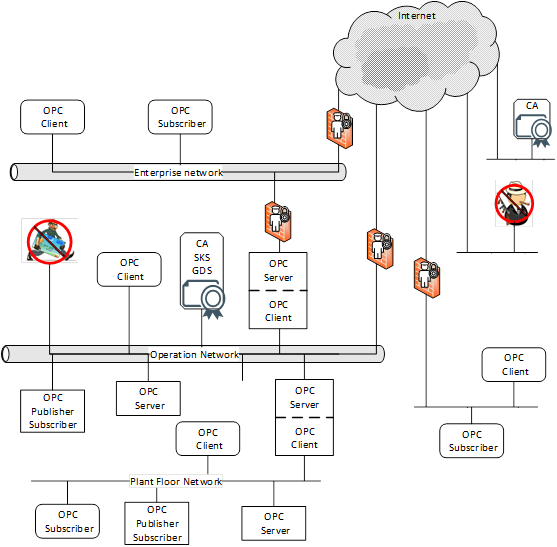
Figure 1 – OPC UA network example
Fundamentally, information system security reduces the risk of damage from attacks. It does this by identifying the threats to the system, identifying the system’s vulnerabilities to these threats, and providing countermeasures. The countermeasures reduce vulnerabilities directly, counteract threats, or recover from successful attacks.
Industrial automation system security is achieved by meeting a set of objectives. These objectives have been refined through many years of experience in providing security for information systems in general and they remain quite constant despite the ever-changing set of threats to systems. They are described in 4.1 and 4.2 reconciles these objectives against the OPC UA functions. Clause 5 offers additional best practice guidelines to Client and Server developers or those that deploy OPC UA Applications.
Entities such as Clients, Servers, and users should prove their identities. Authentication can be based on something the entity is, has, or knows.
The access to read, write, or execute resources should be authorized for only those entities that have a need for that access within the requirements of the system. Authorization can be as coarse-grained as allowing or disallowing a Client to access a Server or it could be much finer grained such as allowing specific actions on specific information items by specific users. The granularity of a system depends in part on the functionality supported by the Server, but in general Authorization should be given based on the need-to-know principle i.e. a user should be granted access only to information they require for the function they are performing.
Data is protected from passive attacks such as eavesdropping, whether the data is being transmitted, in memory, or being stored. To provide Confidentiality, data encryption algorithms using special secrets for securing data are used along with Authentication and Authorization mechanisms for accessing that secret.
Receivers receive the same information that the original sender sent, without the data being changed during transmission.
Repudiation is the rejection or denial of something as valid or true. Non-Repudiation is assuring that something that actually occurred cannot be claimed as having not occurred. A security service that provides this protection can be one of two types:
· One in which the recipient of the data gets and stores information proving that the data came from the originator. This blocks the originator from claiming they never sent the data.
· One in which the sender of the data gets confirmation that the data was received by the recipient as intended.
Actions taken by a system are recorded in order to provide evidence to stakeholders:
· that this system works as intended (successful actions are tracked).
· that identify the initiator of certain actions (user activity is tracked).
· that attempts to compromise the system were denied (unsuccessful actions are tracked).
Availability is impaired when the execution of software that needs to run is turned off or when the software or communication system is overwhelmed by processing input. Impaired Availability in OPC UA can appear as slowing down of Subscription performance or the inability to add Sessions for example.
The inability to discover SymmetricKeys even if the Private Keys used for the key exchange are compromised in the future.
OPC UA provides countermeasures to resist threats to the security of the information that is communicated. 3.3 lists the currently known threats to environments in which OPC UA will be deployed, and 4.1 reconciles these threats against the OPC UA functions.
Denial of service is the prevention of authorized access to a system resource or the delaying of system operations and functions. This can occur from a number of different attack vectors including message flooding, resource exhaustion and application crashes. Each of these are described separately.
Denial of Service impacts Availability.
See 4.1.2 for the reconciliation of this threat.
For Client-Server, an attacker can send a large volume of Messages, or a single Message that contains a large number of requests, with the goal of overwhelming the OPC UA Server or dependent components such as CPU, TCP/IP stack, operating system, or the file system. Flooding attacks can be conducted at multiple layers including OPC UA, HTTP or TCP.
Message flooding attacks can also target a Client, although this is less of a risk, since the Client chooses who to connect to. A Client could receive a flood from a compromised Server which could disrupt the OPC UA Application.
Message flooding attacks can use both well-formed and malformed Messages. In the first scenario, the attacker could be a malicious person using a legitimate Client to flood the Server with requests. Two cases exist, one in which the Client does not have a Session with the Server and one in which it does. Message flooding can impair the ability to establish OPC UA Sessions or terminate an existing Session. In the second scenario, an attacker could use a malicious Client that floods an OPC UA Server with malformed Messages in order to exhaust the Server’s resources.
For PubSub, an attacker can send a large volume of dataset messages with the goal of overwhelming the subscriber, the middleware or dependent components such as CPU, TCP/IP stack, operating system, or the file system. Flooding attacks can be conducted at multiple layers including OPC UA, UDP, AMQP, MQTT.
As in Client-Server, PubSub message flooding attacks can use both well-formed and malformed Messages. For well-formed Messages, the attacker could be one in which the publisher is not a member of the SecurityGroup and one in which it is a member. For malformed Messages, an attacker could use a malicious Publisher that floods a network with malformed Messages in order to exhaust the system’s resources.
In general, Message flooding can impair the ability to communicate with an OPC UA entity and result in denial of service.
An attacker can send a limited number of messages that obtain a resource on the system. The commands are typically valid, but they each use up a resource resulting in a single Client obtaining all resources blocking valid Clients from accessing the Server. For example, on a Server in which only 10 Sessions are available a malicious person using a legitimate Client, could obtain all 10 Sessions. Or a malicious Client could try to open 10 SecureChannels, without actually completing the process.
Resource exhaustion attacks do not occur in the same manner for PubSub communications since no session or resources are allocated. For PubSub communication, the Publisher is not susceptible. In broker-less PubSub communication, the Subscriber can, with the use of filters, bypass any resource exhaustion issues. In broker case, both the Publisher and Subscriber are connected to the broker. Although the Publisher and Subscriber are not directly susceptible (as in the broker-less case), the broker is susceptible. The details for broker communication is not part of this standard but is defined by the broker protocol.
An attacker can send special message that will cause an application to crash. This is usually the result of a known problem in a stack or application. These system bugs can allow a Client to issue a command that would cause the Server to crash, as an alternate it could be a Server that can respond to a legitimate message with a response that would cause the Client to crash. The attacker could also be a Publisher that issues a Message that would cause Subscribers to crash.
Eavesdropping is the unauthorized disclosure of sensitive information that could result directly in a critical security breach or be used in follow-on attacks.
If an attacker has compromised the underlying operating system or the network infrastructure, then the attacker could be able to record and capture Messages. It could be beyond the capability of a Client or Server to recover from a compromised operating system.
Eavesdropping impacts Confidentiality directly and if session establishment is not secured Authentication and Authorization. It also indirectly threatens all other security objectives.
See 4.1.3 for the reconciliation of this threat.
This includes feigning identities (user, application, process etc.). An attacker could forge Messages from a Client or a Server or a Publisher where the messages are forged to attempt to appear to be from an application other that the sending application or process. Spoofing can occur at multiple layers in the protocol stack.
By spoofing Messages from a Client, a Server or Publisher, attackers can perform unauthorized operations and avoid detection of their activities.
Message spoofing impacts Integrity, Authorization and during session / SecureChannel establishment Authentication.
See 4.1.4 for the reconciliation of this threat.
Network traffic and application layer Messages could be captured or modified and forwarded to OPC UA Clients, Servers, and Subscribers. Message alteration could allow illegitimate access to a system.
Message alteration impacts Integrity, Authorization, Auditability, Non-Repudiation and during session / SecureChannel establishment Authentication.
See 4.1.5 for the reconciliation of this threat.
Network traffic and valid application layer Messages could be captured and resent to OPC UA Clients, Servers and Subscribers at a later stage without modification. An attacker could misinform the user or send a valid command such as opening a valve but at an improper time, so as to cause damage or property loss. An attacker could attempt to establish a Session using a recorded Session.
Message replay impacts Authorization and during Session / SecureChannel establishment Authentication. See 4.1.6 for the reconciliation of this threat.
An attacker can craft a variety of Messages with invalid Message structure (malformed XML, UA Binary, etc.) or data values, and send them to OPC UA Clients, Servers or Subscribers.
The OPC UA Client, Server or Subscriber could incorrectly handle certain malformed Messages by performing unauthorized operations or processing unnecessary information. It could result in a denial or degradation of service including termination of the application or, in the case of embedded devices, a complete crash. In a worst-case scenario an attacker could use malformed Messages as a pre-step for a multi-level attack to gain access to the underlying system of an OPC UA Application.
Malformed Messages impacts Integrity and Availability.
See 4.1.7 for the reconciliation of this threat.
An attacker tries to deduce the identity, type, software version, or vendor of the Server or Client in order to apply knowledge about specific vulnerabilities of that product to mount a more intrusive or damaging attack. The attacker could profile the target by sending valid or invalid formatted Messages to the target and try to recognize the type of target by the pattern of its normal and error responses.
Server profiling impacts all of the security objectives indirectly.
See 4.1.8 for the reconciliation of this threat.
An attacker could use information (retrieved by sniffing the communication or by guessing) about a running Session established between two applications to inject manipulated Messages (with valid session information) that allow him or her to take over the Session from the authorized user.
An attacker could gain unauthorized access to data or perform unauthorized operations.
Session hijacking impacts all of the security objectives.
See 4.1.9 for the reconciliation of this threat.
An attacker builds a malicious OPC UA Server or installs an unauthorized instance of a genuine OPC UA Server in a system. The rogue Server can attempt to masquerade as a legitimate UA Server or it can simply appear as a new Server in the system.
The OPC Client could disclose confidential information.
A rogue Server impacts all security objectives except Integrity and Non-Repudiation.
See 4.1.10 for the reconciliation of this threat.
An attacker who builds a malicious OPC UA Publisher or installs an unauthorized instance of a genuine OPC UA Publisher in a system. The rogue Publisher could attempt to masquerade as a legitimate UA Publisher or it could simply appear as a new Publisher in the system.
A rogue Publisher impacts all security objectives except Integrity and Non-Repudiation.
See 4.1.10 for the reconciliation of this threat.
An attacker who builds a malicious Local Discover Server. The malicious Local Discover Server could direct Clients to incorrect Servers, lower the exposed security of listed Servers or hide legitimate Servers. It could also be used to generate incorrect input to a GDS that aggregates information from Local Discovery Servers.
A rogue Discovery Server impacts all security objectives except Integrity and Non-Repudiation.
See 4.1.11for the reconciliation of this threat.
An attacker obtains user credentials such as usernames, passwords, Certificates, or keys by observing them on papers, on screens, or in electronic communications, or by cracking them through guessing or the use of automated tools such as password crackers.
An unauthorized user could launch and access the system to obtain all information and make control and data changes that harm plant operation or information. Once compromised credentials are used, subsequent activities could all appear legitimate.
Compromised user credentials impact Authentication, Authorization and Confidentiality.
See 4.1.12 for the reconciliation of this threat.
An attacker compromises an identity server or provides a rogue identity server. This is similar to 3.3.13, except all credentials are compromised. An unauthorized user could launch and access the system to obtain all information and make control and data changes that harm plant operations or information. Once compromised, invalid users can be used and or granted any roles or rights. Compromised identity services directly impact Authentication and Authorization, but it can indirectly impact all security objectives.
See 4.1.12 for the reconciliation of this threat.
This is not a direct attack, since it is not about communication, but it is the trust following the communication. Repudiation causes trust issues with either the sender or the receiver of the data.
Repudiation impacts Non-Repudiation.
See 4.1.13 for the reconciliation of this threat.
An attacker could try to intercept and block reception of a message. This could be accomplished with a compromised network infrastructure or in other manners. Messages could be blocked in either direction i.e. messages originating from a Client or originating from a Server.
Message suppression impacts Integrity and Availability.
See 4.1.14 for the reconciliation of this threat.
An attacker could attempt to fool a Client into using a less secure connection or deprecated security policy. This could be attempted by modifying a Discovery response to remove security options from the available endpoints.
Message suppression directly impacts Authentication and Authorization, but it can indirectly impact all security objectives.
See 4.1.15 for the reconciliation of this threat.
OPC UA security works within the overall Cyber Security Management System (CSMS) of a site. Sites often have a CSMS that addresses security policy and procedures, personnel, responsibilities, audits, and physical security. A CSMS typically addresses threats that include those that were described in 3.3. They also analyse the security risks and determine what security controls the site needs.
Resulting security controls commonly implement a “defence-in-depth” strategy that provides multiple layers of protection and recognizes that no single layer can protect against all attacks. Boundary protections, shown as abstract examples in Figure 1, can include firewalls, intrusion detection and prevention systems, controls on dial-in connections, and controls on media and computers that are brought into the system. Protections in components of the system can include hardened configuration of the operating systems, security patch management, anti-virus programs, and not allowing email in the control network. Standards that could be followed by a site include NERC CIP and IEC62351 which are referenced in Clause 1.
The security requirements of a site CSMS apply to its OPC UA interfaces. That is, the security requirements of the OPC UA interfaces that are deployed at a site are specified by the site, not by the OPC UA specification. OPC UA specifies features that are intended so that conformant OPC UA Applications can meet the security requirements that are expected to be made by sites where they will be deployed. Those who are responsible for the security at the site should determine how to meet the site requirements with OPC UA conformant products.
The system owner that installs OPC UA Applications should analyse its security risks and provide appropriate mechanisms to mitigate those risks to achieve an acceptable level of security. OPC UA meets the wide variety of security needs that could result from such individual analyses. OPC UA Applications are required to be implemented with certain security features which are available for the system owner’s optional use. Each system owner should be able to tailor a security solution that meets its security and economic requirements using a combination of mechanisms available within the OPC UA specification and external to OPC UA.
The security requirements placed on the OPC UA Applications deployed at a site are specified by the site CSMS, not by the OPC UA specification. The OPC UA security specifications, however, are requirements placed upon OPC UA Applications, and recommendations of how OPC UA should be deployed at a site in order to meet the security requirements that are anticipated to be specified at the site.
OPC UA addresses some threats as described in 3.3. The OPC Foundation recommends that OPC UA Application developers address the remaining threats, as detailed in Clause 5. Threats to infrastructure components that could result in the compromise of operating systems, where OPC UA Applications are running, are not addressed by OPC UA.
The OPC UA security architecture is a generic solution that allows implementation of the required security features at various places in the OPC UA Application architecture. Depending on the different mappings described in OPC 10000-6, the security objectives are addressed at different levels. The OPC UA security architecture, for Client / Server communication is structured in an Application Layer and a Communication Layer atop the Transport Layer as shown in Figure 2.
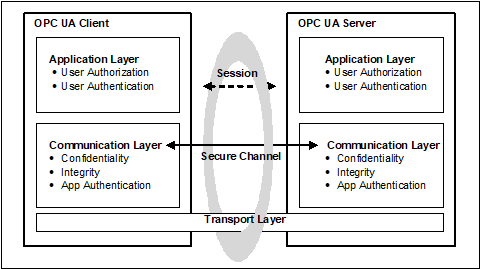
Figure 2 – OPC UA security architecture – Client / Server
OPC UA also supports a Publish - Subscribe communications architecture (PubSub) and the security architecture for that communication is illustrated in Figure 3.
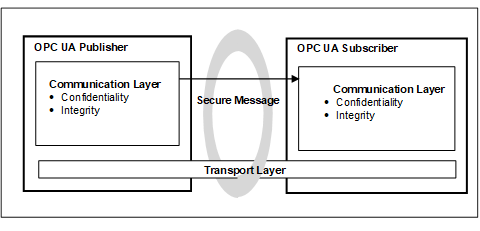
Figure 3 – OPC UA security architecture- Publisher - Subscriber
Client / Server communication can include both Session and session-less communication. Security in part is provided by the application or by the communications layers. It can also utilize transport layer security. Each of these options provides a different set of security objectives and are described in the following sections.
The routine work of a Client application and a Server application to transmit information, settings, and commands is done in a Session in the Application Layer. The Application Layer also manages the security objectives user Authentication and user Authorization (see 3.11 for more detail on user authorization). The security objectives that are managed by the application layer are addressed by the Session Services that are specified in OPC 10000-4. A Session in the application layer communicates over a SecureChannel that is created in the communication layer and relies upon it for secure communication. All of the Session data is passed to the communication layer for further processing.
Although a Session communicates over a SecureChannel and has to be activated before it can be used, the binding of users, Sessions, and SecureChannels is flexible.
Impersonation allows a user to take ownership of an existing Session.
If a SecureChannel breaks, the Session will remain valid for a period of time allowing the Client to re-establish the connection to the Session via a new SecureChannel. Otherwise, the Session closes after its lifetime expires. The requirements for re-establishing connections are described in OPC 10000-4
The Communication Layer provides security mechanisms to meet Confidentiality, Integrity and application Authentication as security objectives. In some cases, it also meets the Perfect Forward Secrecy security objective. One essential mechanism to meet these security objectives is to establish a SecureChannel (see 3.13) that is used to secure the communication between a Client and a Server. The SecureChannel provides encryption to maintain Confidentiality, Message Signatures to maintain Integrity and Certificates to provide application Authentication. In addition, the SecureChannel provides Perfect Forward Secrecy when the SecureChannel is used with ECC and the Diffie Hellman Key Exchange. The data that comes from the Application Layer is secured and passes the “secured” data to the Transport Layer. The security mechanisms that are managed by the Communication Layer are provided by the SecureChannel Services that are specified in OPC 10000-4.
The security mechanisms provided by the SecureChannel services are implemented by a protocol stack that is chosen for the implementation. Mappings of the services to some of the protocol stack options are specified in OPC 10000-6 which define how functions in the protocol stack are used to meet the OPC UA security objectives. Other details are provided as part of Profiles which are described in OPC 10000-7 (and available on-line at https://profiles.opcfoundation.org).
The Communication Layer can represent an OPC UA connection protocol stack. OPC UA specifies alternative stack mappings that can be used as the Communication Layer. These mappings are described in OPC 10000-6.
If the OPC UA Connection Protocol (UACP) is used, then functionality for Confidentiality, Integrity, application Authentication, and the SecureChannel are similar to the https://www.isa.org/products/ansi-isa-62443-4-2-2018-security-for-industrial-au
TLS specifications, as described in OPC 10000-6.
Additional communication mappings are described in OPC 10000-6. These mappings can rely on transport protocols to provide Confidentiality and Integrity. One example is Websockets, which utilizes HTTPS transport layer security to provide Confidentiality and Integrity.
The transport layer handles the transmission, reception, and the transport of data that is provided by the communication layer.
To survive the loss of the transport layer connections (e.g. TCP connections) and resume with a new connection, the communication layer is responsible for re-establishing the transport layer connection without interrupting.
The transport layer can also be used to implement Confidentiality and Integrity by using HTTPS (HTTP messages over a TLS connection) as described in OPC 10000-6. It is important to note that HTTPS certificates can be (and often are) shared by multiple applications on a platform and that they can be compromised outside of the OPC UA usage of them. All applications on the platform that use the same shared certificate have the same settings. HTTPS does not require application Authentication, if this is required it can be included as part of Session establishment.
OPC UA provides a session-less Service invocation (defined in OPC 10000-4 overview and see OPC 10000-6 for details). The session-less communication provides User Authentication via an Access Token. The communication channel provides Confidentiality and Integrity. The communication channel could be an OPC UA SecureChannel (without a session). It could be a communication channel, such as HTTPS, which relies on transport protocols to provide security. In addition, User Authentication and/or Application Authentication can also be established by the use of an AccessToken which is obtained from an AuthorizationService (see OPC 10000-6 for details).
Session-less communication is restricted to encrypted communication channels. It could also be restricted to specific endpoints that are dedicated for session-less communication.
The PubSub can be deployed in two environments, one in which a broker exists and one which is broker less. OPC 10000-14 defines the details of this model. The two environments have different security considerations associated with them, and each will be described separately.
The broker-less PubSub communication model provides Confidentiality and Integrity. This is accomplished using Symmetric Encryption and signature algorithms. The required SymmetricKeys are distributed by a Security Key Server (SKS) (see OPC 10000-14 for additional details). The SKS makes use of the standard Client/Server security described in 3.5.2 to establish application Authentication as well as user Authentication. This approach allows all applications (Publishers and/or Subscribers) in a SecurityGroup to share information.
A benefit of using shared SymmetricKeys is the high performance they offer, but a drawback is that for a group of applications that use a shared SymmetricKey, all of the applications in the group have the same rights. All applications must trust all other applications in the group. Any application (Publisher or Subscriber) in the group can publish a message and any application (Publisher or Subscriber) in the group can decode the message.
For example, a system could be composed of a shared symmetric group that is composed of a controller (Publisher) and three Subscribers (say HMI’s). The controller is publishing messages and the HMIs are receiving the messages. If one of the HMIs is compromised, it could start publishing messages also. The other two HMIs will not be able to tell that the message was not sent from the controller. One possible solution to this situation could be if the shared symmetric group is composed of just the controller and one HMI. Additional groups would be created for each HMI, then no HMI could affect the other HMIs. Other possible solutions could also involve the network architecture and services, such as unicast restricted network communication, but these are outside the scope of the OPC UA specification. The configuration of SecurityGroups requires careful consideration when deploying systems to ensure security. The model is illustrated in Figure 4.
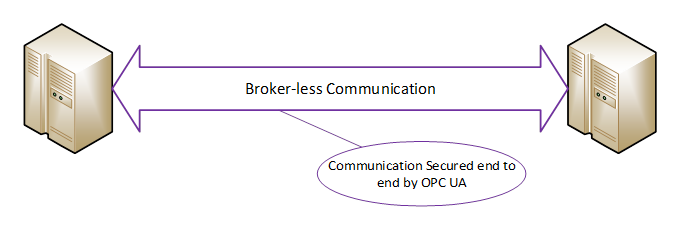
Figure 4 - Boker-less communication
When using a Broker in the PubSub model, the same shared SymmetricKey concepts as defined in 3.5.3.2 can be used to provide Confidentiality and Integrity. Furthermore, communication to the Broker can be secured according the rules defined for the Broker. These rules are not defined in the OPC UA specification but are defined by the Middleware. In many cases the Middleware requires the authorization of both the Publishers and the Subscribers before they can interact with the Broker. The Broker interactions can provide security mechanisms to meet Confidentiality, Integrity and application or user Authentication as security objectives. If the published message is not secured using the shared SymmetricKey concepts, the message content is visible to the Broker which creates some risk of man-in-the-middle attacks. The use of the shared SymmetricKeys eliminates this risk. For complete details on share SymmetricKeys (SKS) and securing PubSub message in Broker based transports see OPC 10000-14. The model is illustrated in Figure 5.
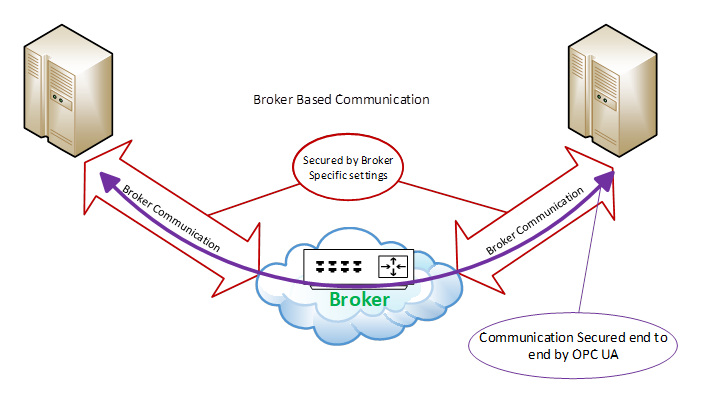
Figure 5 - Broker Communication
A SecurityPolicy specifies which security mechanisms are to be used and are derived from a Security Profile (see 3.7 for details). Security policies are used by the Server to announce which mechanisms it supports and by the Client to select which one to use with the SecureChannel it wishes to open or for the session-less connection it wishes to make. SecurityPolicies are also used with PubSub communication. SecurityPolicies include the following information:
· algorithms for signing and encryption
· algorithm for key derivation
The choice of allowed SecurityPolicies is normally made by the administrator typically when the OPC UA Applications are installed. The available security policies are specified in OPC 10000-7. The Administrator can at a later time also change or modify the selection of allowed SecurityPolicies as circumstances dictate.
The announcement of security policies is handled by special discovery services specified in OPC 10000-4. More details about the discovery mechanisms and policy announcement strategies can be found in OPC 10000-12.
In the Client Server communications pattern, each Client can select a policy independent of the policy selected by other Clients.
For the Publish Subscribe communications pattern, the SecurityPolicy is associated with a published DataSet and all Subscribers utilize the same SecurityPolicy.
Since computing power increases every year, specific algorithms that are considered as secure today can become insecure in the future, therefore, it makes sense to support different security policies in an OPC UA Application and to be able to adopt more as they become available. NIST or other agencies even make predictions about the expected lifetime of algorithms (see NIST 800-57). The list of supported security policies will be updated based on recommendation such as those published by NIST. From a deployment point of view it is important that the periodic site-review checks that the currently selected list of security profiles still fulfil the required security objectives and if they do not, then a newer selection of Security Profiles is selected
There is also the case that new security policies are composed to support new algorithms that improve the level of security of OPC UA products. The application architecture of OPC UA Application should be designed in a way that it is possible to update or add additional cryptographic algorithms to the application with little or no coding changes.
OPC 10000-7 specifies several policies which are identified by a specific unique URI. To improve interoperability among vendors’ products, Server and Publisher products implement these policies rather than define their own. Clients and Subscribers support the same policies.
OPC UA Client and Server products are certified against Profiles that are described in OPC 10000-7. Some of the Profiles specify security functions and others specify other functionality that are not related to security. The Profiles impose requirements on the certified products but they do not impose requirements on how the products are used. A consistent minimum level of security is required by the various Profiles. However, different Profiles specify different details such as which encryption algorithms are required for which OPC UA functions. If a problem is found in one encryption algorithm then the OPC Foundation can define a new Profile that is similar, but that specifies a different encryption algorithm that does not have a known problem. OPC 10000-7 is the informative specification of the Profiles, but Profiles are normatively defined in an on-line application (https://profiles.opcfoundation.org) allowing for updating of Profiles, especially security related profiles, in a more timely manner than allowed by documentation publication cycles.
Security policies are a type of Profile that specifies which of the security setting choices to use in the Session. The security policy does not specify the range of choices that the product offers, they are described in the Profiles that it supports.
These security policies are included in certification testing associated with OPC UA Applications. The certification testing ensures that the standard is followed and that the appropriate security algorithms are supported.
Each security mechanism in OPC UA is provided in OPC UA Applications in accordance with the Profiles with which the OPC UA Application complies. At the site, however, the security mechanisms could be deployed optionally. In this way each individual site has all of the OPC UA security functions available and can choose which of them to use to meet its security objectives.
Security Profiles describe a Profile “None” that is used for testing, but if any other more secure Profiles are available this Profile is disabled by default. Profile “None” provides no security.
OPC UA supports the selection of several security modes: “None”, “Sign”, “SignAndEncrypt”. Security mode “None” can only be used with security Profile None. Security mode “none” is disabled for all other security Profiles. Profile None shall be disabled by default. The choice of “Sign” or “SignAndEncrypt” is dependent on the CSMS, in some applications where data confidentiality is not required, “Sign” is sufficient.
User Authentication is achieved when the Client passes user credentials to the Server as specified via Session Services (described in OPC 10000-4). The Server can authenticate the user with these credentials.
The owner (user) of a Session can be changed using the ActivateSession Service in order to meet needs of the application.
User Authentication is not directly part of the Publish-Subscribe communication pattern but is used as part of the SKS associated with this communication pattern.
OPC UA uses a concept conveying Application Authentication to allow applications that intend to communicate to identify each other. Each OPC UA ApplicationInstance has a Certificate (ApplicationInstanceCertificate) assigned that is exchanged during SecureChannel establishment. The receiver of the Certificate checks whether it trusts the Certificate and based on this check it accepts or rejects the request or response Message from the sender. This trust check is accomplished using the concept of TrustLists. TrustLists are implemented as a CertificateStore designated by an administrator. An administrator determines if the Certificate is signed, validated and trustworthy before placing it in a TrustList. A TrustList also stores Certificate Authorities (CA). TrustLists that include CAs, also include Certificate Revocation Lists (CRLs). OPC UA makes use of these industry standard concepts as defined by other organizations.
In OPC UA, HTTPS can be used to create SecureChannels, however, these channels do not provide Application Authentication. If Authentication is required, it is based on user credentials (User Authentication see 3.9). More details on Application Authentication can be found in OPC 10000-4.
OPC UA provides user authorization based on the authenticated user (see 3.9). OPC UA Applications can determine in their own way what data is accessible and what operations are authorized or they can use Roles (see 3.12). Profiles exist to indicate the support of user credentials to restrict or control access to the address space.
OPC UA provides standard approach for implementing role based security. Servers could choose to implement none, part or all of mechanisms defined in OPC 10000-5 and in OPC 10000-18. The OPC UA approach assigns Permissions to Roles illustrated in Figure 6. Clients are then granted Roles based on connection information (Session creation). Roles could be restricted by User Authentication, Application Authentication, SecurityModes, or Transports. The assignment of Roles and restrictions is application specific, but they can be assigned to all Nodes in a Namespace or to specific Nodes.
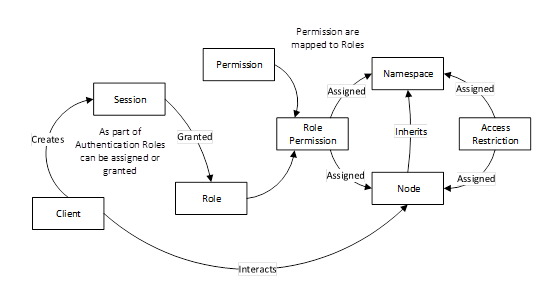
Figure 6 – Role overview
OPC UA defines a set of standard roles that OPC UA Applications can use, these include SecurityAdmin, ConfigureAdmin, Supervisor, Engineer, Operator, Observer and AuthenticatedUser. They are defined in OPC 10000-3 with recommended permissions. The standard roles are also utilized in various other specification as recommended security setting (e.g. see OPC 10000-12). Roles can be assigned via OAuth2 (see 5.12). Role based security is further defined in OPC 10000-18.
The OPC UA Security Services are a group of abstract service definitions specified in OPC 10000-4 that are used for applying various security mechanisms to communication between OPC UA Clients and Servers. OPC 10000-4 provides an overview of security in the “Service Behaviours” section that includes required behaviours to ensure secure communication.
The Discovery Service Set (specified in OPC 10000-4) defines services used by an OPC UA Client to obtain information about the security policies (see 3.6) and the Certificates of specific OPC UA Servers.
The services of the SecureChannel Service Set (specified in OPC 10000-4) are used to establish a SecureChannel which is responsible for securing Messages sent between a Client and a Server. The challenge of the SecureChannel establishment is that it requires the Client and the Server to securely exchange cryptographic keys and secret information in an insecure environment, therefore a specific Key Exchange Algorithm (similar to TLS Handshake protocol defined in https://www.isa.org/products/ansi-isa-62443-4-2-2018-security-for-industrial-au
TLS) is applied by the communication participants.
Once established, a SecureChannel uses Symmetric Cryptography keys to encrypt and sign all Messages. Symmetric Cryptography requires a shared key. Asymmetric Cryptography is used to create this shared key.
The OPC UA Client retrieves the security policies and Certificates of the OPC UA Server by the previously mentioned discovery services. These Certificates contain the Public Keys of the OPC UA Server.
For RSA the following procedure is used:
· The OPC UA Client sends its Public Key in a Certificate and secret information with the OpenSecureChannel service Message to the Server. This Message is secured by applying Asymmetric Encryption with the Server’s Public Key and by generating Asymmetric Signatures with the Client’s Private Key. However, the Certificate is sent unencrypted so that the receiver can use it to verify the Asymmetric Signature.
· The Server decrypts the Message with its Private Key and verifies the Asymmetric Signature with the Client’s Public Key. The secret information of the OPC UA Client together with the secret information of the OPC UA Server is used to derive a set of cryptographic keys that are used for securing all further Messages. Furthermore, all other service Messages are secured with Symmetric Encryption and Symmetric Signatures instead of the asymmetric equivalents.
· The Server sends its secret information in the service response to the Client so that the Client can derive the same set of SymmetricKeys.
For ECC the following procedure is used:
· The OPC UA Client generates a new temporary key pair and sends the Public Key to the Server.
· The Server verifies the signature on the request, then generates a new temporary key pair and sends the Public Key to the Client.
· Once the Public Keys are exchanged, both the Server and Client derive the SymmetricKeys needed for the secure conversation.
Since Clients and Servers have the same set of cryptographic keys they can communicate securely with each other. The SymmetricKeys used in communication can be deciphered if enough messages using the SymmetricKeys are collected and analysed. These derived cryptographic keys are required to be changed periodically so that attackers do not have unlimited time and unrestricted sequences of Messages to use to determine what the SymmetricKeys are. The time period between changes depends on the number of messages sent using the key. Typically for Client Server communication this would be at least every two hours.
For PubSub communications, the security related definitions are specified in OPC 10000-14 and provide a description of how to secure messages and also how to obtain the security keys required for message security.
The Publisher will utilize the keys provided to secure the message. It will encrypt the body of the message and sign the entire message. Subscribers will utilize the keys to decrypt and verify the signature of the messages. These keys are also SymmetricKeys and follow the same rules with regard to periodically changing them. Since PubSub communication is usually at a higher rate, the time period for between key changes would typically be one hour. But in some case it could be even more often depending on the number of messages secured with the key.
To obtain the required keys, the Publisher or Subscriber make use of Client – Server communication. The keys could also be obtained using session-less method calls.
Clients and Servers generate audit records of successful and unsuccessful connection attempts, results of security option negotiations, configuration changes, system changes, user interactions and Session rejections.
OPC UA provides support for security audit trails through two mechanisms.
First, it provides for traceability between Client and Server audit logs. The Client generates an audit log entry for an operation that includes a request. When the Client issues a service request, it generates an audit log entry and includes the local identifier of the log entry in the request sent to the Server. The Server logs requests that it receives and includes the Client’s entry id in its audit log entry. In this fashion, if a security-related problem is detected at the Server, the associated Client audit log entry can be located and examined. OPC UA does not require the audit entries to be written to disk, but it does require that they be available. OPC UA provides the capability for Servers to generate Event Notifications that report auditable Events to Clients capable of processing and logging them. See OPC 10000-4 for more details on how services in OPC UA are audited.
Second, OPC UA defines audit parameters to be included in audit records. This promotes consistency across audit logs and in Audit Events. OPC 10000-5 defines the data types for these parameters. Other information models can extend the audit definitions. OPC 10000-7 describes Profiles which include the ability to generate Audit Events and use these parameters, including the Client audit record id.
Because the audit logs are used to prove that the system is operating securely, the audit logs themselves should also be secured from unauthorized tampering. If someone without authorization were able to alter or delete log records, this could hide an actual or attempted security breach. Because there are many different ways to generate and store audit logs (e.g. files or database), the mechanisms to secure audit logs are outside the scope of this specification.
In addition, the information in an audit record could contain sensitive or private information, thus the ability to subscribe for Audit Events is restricted to appropriate users and/or applications. As an alternative, the fields with sensitive or private information can instead contain an error code indicating access denied for users that do not have appropriate rights.
The subclauses 3.14.2, 3.14.3, 3.14.4 and 3.14.5 illustrate the behaviour of OPC UA Servers and Clients that support Auditing.
Figure 7 illustrates the simple case of a Client communicating with a Server.
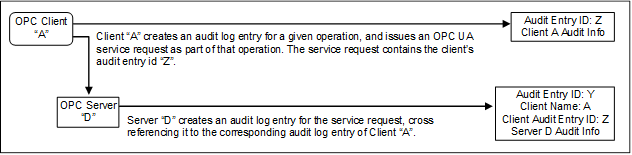
Figure 7 – Simple Servers
In this case, OPC Client “A” executes some auditable operation that includes the invocation of an OPC UA service in Server “D”. It writes its own audit log entry, and includes the identifier of that entry in the service request that it submits to the Server.
The Server receives the request and creates its own audit log entry for it. This entry is identified by its own audit id and contains its own Auditing information. It also includes the name of the Client that issued the service request and the Client audit entry id received in the request.
Using this information, an auditor can inspect the collection of log entries of the Server and relate them back to their associated Client entries.
Figure 8 illustrates the case of a Client accessing services from an aggregating Server. An aggregating Server is a Server that provides its services by accessing services of other OPC UA Servers, referred to as lower layer-Servers.
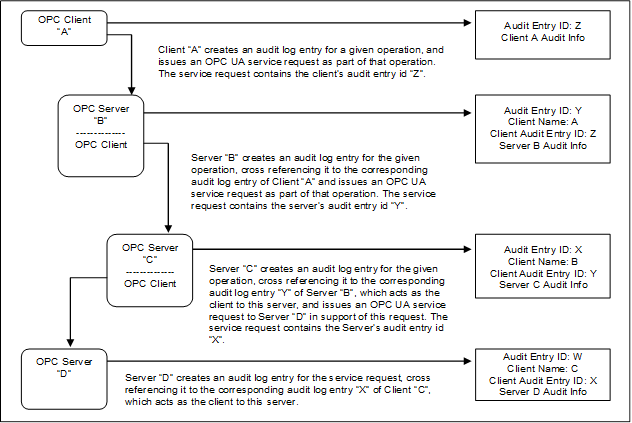
Figure 8 – Aggregating Servers
In this case, each of the Servers receives requests and creates its own audit log entry for them. Each entry is identified by its own audit id and contains its own Auditing information. It also includes the name of the Client that issued the service request and the Client audit entry id received in the request. The Server then passes the audit id of the entry it just created to the next Server in the chain.
Using this information, an auditor can inspect the Server’s log entries and relate them back to their associated Client entries.
In most cases, the Servers will only generate Audit Events, but these Audit Events will still contain the same information as the audit log records. In the case of aggregating Servers, a Server would also be required to subscribe for Audit Events from the Servers it is aggregating. In this manner, Server “B” would be able to provide all of the Audit Events to Client “A”, including the Events generated by Server “C” and Server “D”.
Figure 9 illustrates the case of a Client accessing services from an aggregating Server that does not support Auditing.
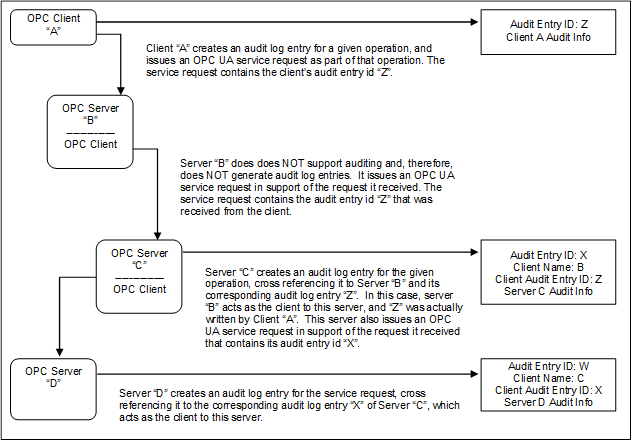
Figure 9 – Aggregation with a non-auditing Server
In this case, each of the Servers receives requests and creates their own audit log entry for them, with the exception of Server “B”, which does not support Auditing. In this case, Server “B” passes the audit id it receives from its Client “A” to the next Server. This creates the required audit chain. Server “B” is not listed as supporting Auditing. In a case where a Server does not support writing audit entries, the entire system can be considered as not supporting Auditing.
In the case of an aggregating Server that does not support Auditing, the Server would still be required to subscribe for Audit Events from the Servers it is aggregating. In this manner, Server “B” would be able to provide all of the Audit Events to Client “A”, including the event generated by Server “C” and Server “D”, even though it did not generate an Audit event.
Figure 10 illustrates the case of a Client that submits a service request to an aggregating Server, and the aggregating service supports that service by submitting multiple service requests to its underlying Servers.
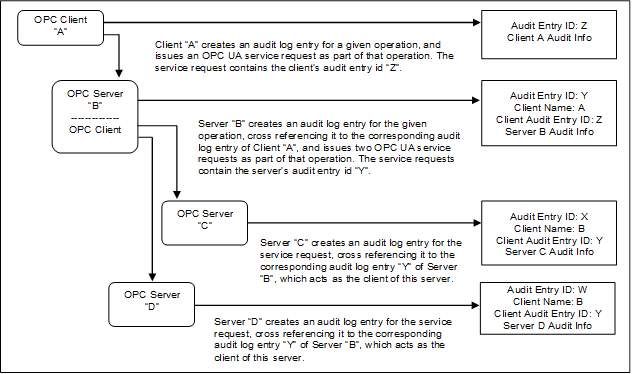
Figure 10 – Aggregating Server with service distribution
In the case of aggregating Servers, a Server would be required to subscribe for Audit Events from the Servers it is aggregating. In this manner, Server “B” would be able to provide all of the Audit Events to Client “A”, including the event generated by Server “C” and Server “D”.
The following sub-clauses 4.1.2 through 4.1.15 reconcile the threats that were described in 3.3 against the OPC UA functions. Compared to the reconciliation with the objectives that will be given in 4.2, this is a more specific reconciliation that relates OPC UA security functions to specific threats. A summary of the reconciliation is available in Table 1. Only eavesdropping and Server profiling require SignAndEncrypt while all other are mitigated with SignOnly. [ (X) indicates indirectly].
Table 1 – Security Reconciliation Threats Summary
|
Attacks |
Authentication |
Authorization |
Confidentiality |
Integrity |
Auditability |
Availability |
Non-Repudiation |
|
Denial of Service |
|
|
|
|
|
X |
|
|
Eaves Dropping |
X |
X |
X |
|
|
|
|
|
Message Spoofing |
|
X |
|
|
|
|
|
|
Message Alteration |
X |
X |
|
X |
X |
|
X |
|
Message Replay |
X |
X |
|
|
|
|
|
|
Malformed Messages |
|
|
|
|
|
X |
|
|
Server Profiling |
(X) |
(X) |
(X) |
(X) |
(X) |
(X) |
(X) |
|
Session Hijacking |
X |
X |
X |
X |
X |
X |
X |
|
Rogue Server |
X |
X |
X |
|
X |
X |
|
|
Rogue Publisher |
X |
|
X |
|
X |
X |
|
|
Rogue Local Discovery |
X |
X |
X |
|
X |
X |
|
|
Compromising User Credentials |
X |
X |
X |
|
|
|
|
|
Repudiation |
|
|
|
|
|
|
X |
|
Message Suppression |
|
|
|
X |
|
X |
|
|
Downgrade Attack |
X |
X |
|
|
|
|
|
See 3.3.2 for a description of this threat. For discussion purposes denial of service is broken into three major categories message flooding, resource exhaustion and application crashes.
OPC UA minimizes the loss of Availability caused by Message flooding by minimizing the amount of processing done with a Message before the Message is authenticated. This prevents an attacker from leveraging a small amount of effort to cause the legitimate OPC UA Application to spend a large amount of time responding, thus taking away processing resources from legitimate activities.
GetEndpoints (specified in OPC 10000-4) and OpenSecureChannel (specified in OPC 10000-4) are the only services that the Server handles before the Client is authenticated. The response to GetEndpoints is only a set of static information so the Server does not need to do much processing. The response to OpenSecureChannel consumes significant Server resources because of the signature and encryption processing. OPC UA has minimized this processing, but it cannot be eliminated.
The Server implementation could protect itself from floods of OpenSecureChannel Messages in two ways.
First, the Server could intentionally delay its processing of OpenSecureChannel requests once it receives more than some minimum number of bad OpenSecureChannel requests. It should also issue an alarm to alert plant personnel that an attack is underway that could be blocking new legitimate OpenSecureChannel calls.
Second, when an OpenSecureChannel request attempts to exceed the Server’s specified maximum number of concurrent channels the Server replies with an error response without performing the signature and encryption processing. Certified OPC UA Servers are required to specify their maximum number of concurrent channels in their product documentation as specified in OPC 10000-7.
OPC UA user and Client Authentication reduce the risk of a legitimate Client being used to mount a flooding attack. See the reconciliation of Authentication in 4.2.3.
The Client protects itself from floods by have a max message size limit, automatically closing connections where the limit is exceeded. The Clients also ignore extra responses that could be received and closes the connection.
In PubSub, the Subscriber filters messages that it processes based on header information, allowing it to quickly discard any messages that do not conform to its required filter. In addition, the message signature is checked to eliminate any message that is well formed, but not from the desired SecurityGroup. PubSub can also be configured for unicast instead of multicast, which allows the network infrastructure to block multicast flooding attacks.
OPC UA Auditing functionality provides the site with evidence that can help the site discover that flooding attacks are being mounted and find ways to prevent similar future attacks (see 3.14). As a best practice, Audit Events should be monitored for excessive connection requests.
OPC UA relies upon the site CSMS to prevent attacks such as Message flooding at protocol layers and systems that support OPC UA.
OPC UA user and Client Authentication reduce the risk of a legitimate Client being used to mount a resource exhaustion attack. Additionally, Server Auditing allows the detection of the Client if a resource exhaustion attack was carried out by a legitimate Client. Servers are also required to recycle OpenSecureChannel request that have not been completed (specified in OPC 10000-4), this will eliminate attacks from non-legitimate Clients. Resource exhaustion attacks do not apply to PubSub Systems, since no sessions or resources are allocated.
OPC UA provides certification of OPC UA Applications. The lab testing and certification includes testing by injecting error and junk commands which could discover common faults. OPC Foundation stacks are also fuzz tested to ensure they are resilient to errors. Although a certified OPC UA Application does not guarantee fault free operation, the certified OPC UA Application is more likely to be resilient to application crashes caused by denial of service attacks.
See 3.3.3 for a description of this threat.
OPC UA provides encryption to protect against eavesdropping as described in 4.2.5.
See 3.3.4 for a description of this threat.
As specified in OPC 10000-4 and OPC 10000-6, OPC UA counters Message spoofing threats by providing the ability to sign Messages. Additionally, Messages will always contain a valid SessionId, SecureChannelId, RequestId and Timestamp as well as the correct sequence number. OPC UA when operating as part of a Session, restricts user spoofing in the same manner since the user information is provided as part of the Session establishment. It is important that when a device starts up that the SessionId that is initially assigned to the first Session is a random number or a continuation of the last Session number used and is not always reset to 0 or a predictable number.
As specified in OPC 10000-14, OPC UA PubSub counters Message spoofing threats by providing the ability to sign messages. Messages can also contain a valid PublisherId, DataSetClassId, timestamp information, network message number and sequence number, which further restricts Message spoofing.
In session-less communication, to counter message spoofing Clients and Server should restrict session-less communication to be over SecureChannels. See 3.5.2.5 and for additional session-less security related information.
See 3.3.5 for a description of this threat.
OPC UA counters Message alteration by the signing of Messages that are specified in OPC 10000-4 and OPC 10000-14. If Messages are altered, checking the signature will reveal any changes and allow the recipient to discard the Message. This check can also prevent unintentional Message alteration due to communication transport errors.
See 3.3.6 for a description of this threat.
OPC UA uses SessionIds, SecureChannelIds, Timestamps, sequence numbers and RequestIds for every request and response Message. Messages are signed and cannot be changed without detection, therefore it would not be possible to replay a Message without it being detected and rejected. The establishment of a SecureChannel or Session includes the same signature, timestamps and sequence number that are part of all messages and thus cannot be replayed.
OPC UA PubSub uses PublisherIds, DataSetWriterIds, Timestamps, network message numbers and sequence numbers in published messages. When Messages are optionally signed they cannot be changed without detection, therefore it can be configured that replay of a message is not possible. It is worth noting that PubSub does allow the disabling of fields in a message. The disabling of the Timestamp, network message number and sequence number, could allow replay attacks. If a replay attack is of concern in a CSMS, then these fields need to be enabled.
For session-less communication, OPC UA uses Timestamps, sequence numbers and RequestIds for every request and response Message. Messages are signed and cannot be changed without detection therefore it would not be possible to replay a Message.
See 3.3.7 for a description of this threat.
Implementations of OPC UA Applications counter threats of malformed Messages by checking that Messages have the proper form and that parameters of Messages are within their legal range. Invalid Messages are discarded. This is specified in OPC 10000-4, OPC 10000-6 and OPC 10000-14.
See 3.3.8 for a description of this threat.
OPC UA limits the amount of information that Servers provide to Clients that have not yet been identified. This information is the response to the GetEndpoints service specified in OPC 10000-4.
See 3.3.9 for a description of this threat.
OPC UA counters Session hijacking by assigning a security context (i.e. SecureChannel) with each Session as specified in the CreateSession Service in OPC 10000-4. Hijacking a Session would thus first require compromising the security context.
See 3.3.10 and 3.3.11 for a description of this threat.
OPC UA Client applications counter the use of rogue Servers by validating Server ApplicationInstanceCertificates. There would still be the possibility that a rogue Server provides a Certificate from a trusted OPC UA Server, but since it does not possess the appropriate Private Key (because this will never be distributed) to decrypt Messages secured with the correct Public Key the rogue Server would never be able to read and misuse secured data sent by a Client. Also, without the Private Key the Server would never be able to sign a response message to a Client.
If communication is secured using ECC, then the Client would refuse to establish a SecureChannel with the rogue Server. If a rogue server attempted to hijack a running connection, it would not be able to generate signed messages to the Client. OPC UA Subscriber applications counter the effect of a rogue Publisher by validating the signature on the published messages.
See 3.3.12 for a description of this threat.
OPC UA Client can counter a rogue Discovery Server, by only connecting to Servers that are trusted. This protects the Client against malicious Server. The use of a GDS can also mitigate the effect of a compromised Local Discovery Server.
A GDS, that aggregates information from Local Discovery Servers does not trust the input from the Local Discovery Servers, until it is confirmed. Confirmation can occur by the Server application registration for certificate services or other secure access to the GDS. It can also be confirmed by administrative personnel.
See 3.3.11 for a description of this threat.
OPC UA protects user credentials sent over the network by encryption as described in 4.2.5.
When using an AuthorizationService for identity verification then securing the user identity is out of scope for OPC UA. It is essential that the CSMS take AuthorizationServices into account. OPC UA depends upon the site CSMS to protect against other attacks to gain user credentials, such as password guessing or social engineering.
The risk from a compromised AuthorizationService can be minimized by restricting Server access in additional manners, such as from specific applications (Clients) or at specific times.
See 3.3.15 for a description of this threat.
OPC UA Client and Server applications counter Repudiation by the signing of Messages that are specified in OPC 10000-4. A signed message within a secure channel indicates that the message originated from the owner of the private key. During OpenSecureChannel and Session establishment the communicating parties are clearly identified and confirmed. Lastly Auditing as described in OPC 10000-4 will track the information associated with the message.
See 3.3.16 for a description of this threat. A Client and Server can counter message suppression by using checking the SequenceNumber in the sequence header. A SecureChannel is required to be closed if a SequenceNumber is missed. This allows both a Server and a Client to detect if a message is supressed. Both the Server and Client are required to report the error (Bad_SequenceNumberInvalid).
See 3.3.17 for a description of this threat. A Client can counter a downgrade attack, by verifying the available communication options once a secure connection is established to the Server. If the list of secure connection provided in activate Session is different from the list provided in discovery, the Client disconnects and reports an error (see OPC 10000-4). Downgrade attacks can also be countered by not enabling lower security options system wide.
The following sub clauses reconcile the objectives that were described in 3.2 with the OPC UA functions. Compared to the reconciliation against the threats of 4.1, this reconciliation justifies the completeness of the OPC UA security architecture.
OPC UA Applications support Authentication of the entities with which they are communicating. As specified in the GetEndpoints and OpenSecureChannel services in OPC 10000-4, OPC UA Client and Server applications identify and authenticate themselves with X.509 v3 Certificates and associated private keys (X.509 v3 Certificates are defined in [X509]). Some choices of the communication stack require these Certificates to represent the machine or user instead of the application.
For publish subscribe communications Client Server communications is required to obtain the shared keys from a SecurityKeyService (SKS). Although the application authentication is not directly between the Subscriber and the Publisher, the SKS ensures that only authenticated applications can obtain the keys used by the Publisher and Subscriber.
OPC UA Applications support Authentication of users by providing the necessary Authentication credentials to the other entities. As described in the ActivateSession service in OPC 10000-4, the OPC UA Client accepts a UserIdentityToken from the user and passes it to the OPC UA Server. The OPC UA Server authenticates the user token. OPC UA Applications accept tokens in any of the following forms: username/password, X.509 v3 Certificate (see [X509]), or JSON Web Token (JWT).
As specified in the CreateSession and ActivateSession Services in OPC 10000-4, if the UserIdentityToken is a Certificate then this token is validated with a challenge-response process. The Server provides a Nonce and signing algorithm as the challenge in its CreateSession response. The Client responds to the challenge by signing the Server’s Nonce and providing it as an argument in its subsequent ActivateSession call.
For session-less services User Authentication can be accomplished using an AccessToken which is obtained from an AuthorizationService (see OPC 10000-6 for details). This does require that an encrypted communication channel be used (see OPC 10000-4 for a general overview).
Authorization could be provided via Roles (3.12) and supplied by a Authorization Server in a GDS. In an environment of mixed vendor products, the GDS can provide a consistent Authorization management. OPC UA Applications that are part of a larger industrial automation product can manage Authorizations consistent with the Authorization management of that product. Identification and Authentication of users is specified in OPC UA so that Client and Server applications can recognize the user in order to determine the Authorization level of the user.
OPC UA Servers respond with the Bad_UserAccessDenied error code to indicate an Authorization or Authentication error as specified in the status codes defined in OPC 10000-4.
In PubSub interactions user Authorization can be used as part of the key distribution (SKS). This allows the Publisher and SKS to restrict access to specific users
OPC UA uses Symmetric and Asymmetric Encryption to protect Confidentiality as a security objective. Thereby Asymmetric Encryption is used for key agreement and Symmetric Encryption for securing all other Messages sent between OPC UA Applications. Encryption mechanisms are specified in OPC 10000-6 and OPC 10000-14.
OPC UA relies upon the site CSMS to protect Confidentiality on the network and system infrastructure. OPC UA relies upon the PKI (public key infrastructure) to manage keys used for Asymmetric Encryption which is then used to establish symmetric session keys. The length of the certificate chain is defined by the site CSMS (only local TrustList with self-signed Certificates or a full CA/CRL infrastructure).
OPC UA uses Symmetric and Asymmetric Signatures to address Integrity as a security objective. The Asymmetric Signatures are used in the key agreement phase during the SecureChannel establishment. The Symmetric Signatures are applied to all other Messages including PubSub messages.
OPC UA relies upon the site CSMS to protect Integrity on the network and system infrastructure. OPC UA relies upon the PKI to manage keys used for Asymmetric Signatures which is then used to establish symmetric session keys.
As specified in the UA Auditing description in OPC 10000-4, OPC UA supports Audit logging by providing traceability of activities through the log entries of the multiple Clients and Servers that initiate, forward, and handle the activity. OPC UA depends upon OPC UA Application products to provide an effective Audit logging scheme or an efficient manner of collecting the Audit Events of all nodes. This scheme can be part of a larger industrial automation product of which the OPC UA Applications are a part.
OPC UA minimizes the impact of Message flooding as described in 4.1.2.
Some attacks on Availability involve opening more Sessions than a Server can handle thereby causing the Server to fail or operate poorly. Servers reject Sessions that exceed their specified maximum number. Other aspects of OPC UA such as OPC UA Secure Conversation can also affect availability and are discussed in OPC 10000-6.
Clause 5 provides guidance to vendors that implement OPC UA Applications. Since many of the countermeasures required to address the threats described above fall outside the scope of the OPC UA specification, the advice in Clause 5 suggests how some of those countermeasures should be provided.
For each of the following areas, Clause 5 defines the problem space, identifies consequences if appropriate countermeasures are not implemented and recommends best practices.
Timeouts, the time that the implementation waits (usually for an event such as Message arrival), play a very significant role in influencing the security of an implementation. Potential consequences include
· Denial of service: Denial of service conditions could exist when a Client does not reset a Session, if the timeouts are very large.
· Resource consumption: When a Client is idle for long periods of time, the Server keeps the Client’s buffered Message or information for that period, leading to resource exhaustion.
The implementer should use reasonable timeouts for each connection stage.
The specifications often specify the format of the correct Messages and are silent on what the implementation should do for Messages that deviate from the specification. Typically, the implementations continue to parse such packets, leading to vulnerabilities.
· The implementer should do strict checking of the Message format and should either drop the packets or send an error Message as described below.
o Error handling uses the error code, defined in OPC 10000-4, which most precisely fits the condition and only when returning an error code is appropriate. Error codes can be used as an attack vector; thus, their uses shall be limited as described in Part 4 Service Behaviours clause. Once the SecureChannel has been established then appropriate specific error codes are returned.
o Another attack vector that can be used is timing variations; this is minimized by the description in Part 4 that requires the closing of the socket for any errors when establishing a SecureChannel. Vendors should be careful in their implementation to ensure that all paths that result in the closure of the socket do not provide a timing hint indicating which failure path was encountered. This can be accomplished by having a random delay before closing the socket or before returning a generic error code.
· All array lengths, string lengths and recursion depth should be strictly enforced and processed.
Random numbers that meet security needs can be generated by suitable functions that are provided by cryptography libraries. Common random functions such as using rand() provided by the “C” standard library do not generate enough entropy. As an alternative, implementers could use the random number generators provided by the Microsoft Windows Crypto library (WinCrypt library) or by OpenSSL. Even the random functions provided in cryptography libraries require a source of entropy to initialize and the required entropy is not always available on embedded devices. PCs can use several individual pieces of information (hardware ids like CPU, MAC addresses, USB devices, screen resolution, installed software ...) to generate entropy, but embedded devices are built completely identically. Often only the time and possibly a MAC address is left for entropy. These sources of entropy can be guessed or discovered. This makes the embedded devices very vulnerable.
A common mistake is to generate cryptographic keys during the first boot. Thus even the time information is predictable (creation time is stored e.g. in a certificate). Some alternate solutions a vendor could want to consider:
· Add specific entropy generator hardware when designing embedded devices.
· Do not generate certificates on embedded devices. Use an external tool or the GDS to generate the certificate and load it onto the device. A problem could still remain for the SymmetricKeys, as these are normally not created directly during the boot phase; rather they are created when a client connects.
· Wait long enough until enough entropy information is available. Some operating systems provide hints when they have reached this point.
· For embedded systems without a good entropy source, it is helpful to store the cryptographic pseudo-random number generator (CPRNG) state, so that it will not produce the same random numbers after every boot.
Vendor should ensure that cryptographic functions they use are initialized with suitable entropy and that the generated certificates are not created in a predictable manner.
The implementation understands and correctly interprets any Message types that are reserved as special (such as broadcast and multicast addresses in IP specification). Failing to understand and interpret those special packets leads to vulnerabilities.
OPC UA does not provide rate control mechanisms, however an implementation can incorporate rate control.
OPC UA describes that certain functionality, such as the management of CertificateStores, should be restricted to administrators. This Multi-part standard does not describe the details associated with administrative access. The nature of administrative access varies from platform to platform. Some platforms only have a single administrator. Other platforms provide multiple levels of administrative access such as backup administrator, network administrator, configuration administrator etc. The deployment site should make appropriate selections for administrator access and the implementer should allow for the configuration of appropriate administrator account access.
Administrative access restrictions include items such as configuration files for Servers and Clients. For example, configuration files could contain paths to certificate stores or exposed endpoints both of which if changed could cause major issues.
Administrative access should also be used to control Audit Events, see 3.14 for additional details.
Security Profiles listed in Part 7 describe required algorithms and required key lengths. Key length requirements are often specified as a range, i.e., 1024-2048. It is important that an OPC UA Application supports the entire range for its ApplicationInstanceCertificate. This allows an end user to generate a key (ApplicationInstanceCertificate) that meets their security requirements. This often extends the period of time for which the given Security profile can be used. For example, key lengths less than 2048 are already considered insecure, but if an end user generates certificates for the high end of the range (2048), the application could still be considered secure (depending on the other algorithms).
OPC UA supports a robust Alarm and Condition information model which includes the ability to disable alarms, shelve alarms, and to generally manage alarms. Alarm processing and management is an important part of maintaining efficient control of a plant. From a security point of view it is important that this avenue be adequately protected, to ensure that a rogue agent does not create a dangerous or financial situation. OPC UA provides the tools required for this protection, but the implementer needs to ensure that they are exercised correctly. All functions that allow changes to the running environment are able to generate Audit Events and are to be restricted to appropriate users.
The disabling of Alarms is one such function that should be restricted to personnel with appropriate access rights. Furthermore, any action that disables an alarm, whether it be initiated by personnel or some automated system, should generate an Audit Event indicating the action.
The shelving of alarms should follow similar guideline as the disabling of alarms with regard to access and Auditing, although it is often available to a wider range of users (operators, engineers). Also, the implementer should ensure that appropriate timeouts are configured for Alarm Shelving. These timeouts should ensure that an Alarm cannot be shelved for a period of time that could cause safety concerns.
Dialog Events could also be used to overload a Client. It would be a best practice for Servers that support dialogs to restrict the number of concurrent dialogs that could be active. Also, Dialogs should include some timeout period to ensure that they are not used to create a DOS. Client implementers should also ensure that any dialog processing cannot be used to overwhelm an operator. The maximum number of open dialogs should be restricted and dialogs should be able to be ignored (i.e. other processing should still be available).
OPC UA describes functionality that allows for programs to be executed as part of the OPC UA Server. These programs can be used to perform advanced control algorithms or other actions. The use of these actions should be restricted to personnel with appropriate access rights. Furthermore, the definition of Programs should be carefully monitored. It is recommended that statistics be maintained regarding the number of defined programs in addition to their execution frequency. This information is available to administrative personnel. In no case should an unlimited number of program executions be allowed.
The OPC UA specification describes Audit Events that are to be generated and the information that these Audit Events include as a minimum, however, the specification does not describe how these Audit Events are handled once they are generated. Audit Events can be subscribed to by multiple Audit tracking systems or logging systems. The OPC UA specification does not describe these systems. It is assumed that any number of vendor provided systems could provide this functionality. As a best practice whatever system is used to store and manage, Audit Events should ensure the following:
· That Audit Events are not tampered with once they are received.
· The Subscription for Audit Events should be via a SecureChannel to ensure they are not tampered with while in transition.
· For Clients that log audit events; it is recommended that the logged audit events be persisted in such a manner that the audit events can be authenticated and linked to the original transaction.
An Audit event management system could have additional requirements based on the site CSMS.
OAuth2 defines a standard for Authorization Services that produce JSON Web Tokens (JWT), also known as AccessTokens. These JWTs are passed as an Issued Token to an OPC UA Server which uses the signature contained in the JWT to validate the token. JWT can also provide information to the Server regarding the roles associated with the Authenticated user. The enforcement of the roles is the responsibility of the Server. OPC 10000-4, OPC 10000-5, OPC 10000-6 and OPC 10000-18 describes OAuth2 and JWTs in more detail. Sites should ensure that they follow the best practices defined in the site CSMS for OAuth2.
If a GDS is available in the system, it could provide Authorization Services as defined in OPC 10000-12.
HTTPs defines a standard transport security. This transport security does not always ensure end to end security. Proxy servers or other intermediaries can exist. If end to end security is required then additional step such as a VPN should be taken.
If TLS communication is supported, the keys used for TLS must be different then the keys for TCP communication. Reusing the keys introduces security issues. Versions of TLS older than 1.2 have security flaws and should not be enabled. It is recommended to only support TLS configurations provided in the TransportSecurity Profiles.
SSL has security issues and should be disabled. It is important that it is disabled for all applications on the machine not just for the UA application.
Websockets is just another protocol that is secured using HTTPS. If using Websockets, all of the security guideline for HTTPs and TLS should be followed.
Reverse connect allows a Server to initiate the connection to a Client (open the socket sending a HEL message). This results in an additional security concern for the Client, in that the Client needs to validate that the connection is from an appropriate Server and not a denial of service attack. The Client follows the process described in Part 6 “Client and Server Handshaking during Reverse Connect” table, including checks related to the ServerUri and EndpointUrl.
This standard describes one option for user security as username/password. If username / passwords are used, they should follow site specific rules and passwords shall be secured both in transit and in storage. Usernames should be able to be changed. Passwords shall not be hardcoded as part of an application. They shall be able to be managed by administrative users. Passwords should follow the password complexity and timeout rules associated with a site CSMS.
If an OPC UA Application becomes aware of compromised credentials, which could be application level or user level credentials, the application should terminate any connection using the compromised credentials. The compromised credential could be determined via a GDS or other global service or they could be detected by some out of band process.
When a Client connects to a Server, the Client should be granted the minimum privileges that it requires to function. In OPC UA a Client can request additional privileges by changing the UserIdentityToken (see Activate Session in OPC 10000-4). This could even be done for a short period of time. Roles such as SecurityAdmin or ConfigureAdmin should not be granted to a user except when the user is actively performing duties associated with that Role.
The concept of zero trust is an environment where the network is not trusted and all application and communication between them needs to be approved (i.e., Authenticated and Authorized). Zero trust environments do not rely on perimeter defences. Many of the key concepts described in zero trust follow key concepts describe in this document. For a more complete overview of the core principles in zero trust see ZeroTrustCore.
OPC UA, with its built-in security capabilities, is a very good fit for a zero trust environment. The capability to assign permissions down to individual Nodes, the ability to provide both application level and user level authentication, and support for central management of Authorization and Authentication (GDS functionality), are all concepts desired in a zero-trust environment. Another key tenant of a zero trust architecture is the concept of least-privilege, which can easily be applied using OPC UA.
Some key concepts related to a zero trust network is that the network is not trusted and that devices on the network are not trusted
A key point is that information that is flowing between the enterprise network and non-enterprise network needs to have consistent security policies. Furthermore, for a zero trust architecture additional safe guards should be in-place like diagnostics and monitoring systems, network logging, access policies, a PKI infrastructure and User identification systems. For additional details on the architecture of zero trust network see ZeroTrustArchitecture
OPC UA is designed to operate in a multi-vendor environment, where devices from many vendors (not all of which would be trusted) could be operating. The hardware and software on these devices could be owned by the enterprise or they could be owned by others. OPC UA is designed to assign trust as needed, not inheritably trusting any device. Having standardized security policies and settings (as defined in OPC 10000-100, OPC UA Specification: Part 100 – Devices
https://www.opcfoundation.org/UA/Part100/
OPC Security Policies) provides a consistent security policy and posture.
In zero trust architecture, OPC UA Auditing would be required as an integral part of a continuous diagnostics system. The individual privileges and roles that are available in OPC UA can be part of the data access policies. The support for a GDS in all Servers and Client allows an Enterprise PKI system to be deployed. The GDS can be linked to identity management systems.
The key point is that even though OPC UA is not a complete zero trust environment, it provides many of the required aspects of a zero trust environment.
Diagnostics are an important tool in troubleshooting problems in a Server, Client or system, but it is important that security sensitive information not be provided as part of diagnostic information. Security information shall only be available to security Administrators. Providing security related information via diagnostics to non-security personnel can provide information that can be used to compromise a system.
In addition, diagnostics can provide trace information describing the overall structure of Server. This type of diagnostic shall only be provided to Authenticated Clients.
OPC UA provides a number of services that do not require security to access. These services require special consideration from a security point of view. These services, also known as Discovery Services, provide capabilities that allow Clients to discover Servers and connect to them. The Discovery Services are available as local services or global services and can be multicast.
Discovery Services can be provided by a Local Discovery Server or by the Server. A Local Discovery Server is used when more than one OPC UA Application could be available on a single platform. If only one dedicated Server is available on a platform, usually that Server also functions as a Discovery Server. The Local Discovery Server exposes the following services that do not require OPC UA security: FindServers, and GetEndpoints. See the recommendations described in OPC 10000-4 related to these unsecured services.
OPC UA can be configured to support discovery in multiple manners. One of the options is a multi-cast discovery. In this type of Discovery, Servers announce themselves on a subnet when they start. Application machines or an actual application can listen and build a list of the available Servers.
Multicast DNS operations are insecure because of their very nature; they allow rogue Servers to broadcast their presence or impersonate another host or Server. Risks from Rogue Servers can be minimized if OPC UA security is enabled and all applications use certificate TrustLists to control access. Also, Clients should cache connection information, minimizing the lookup of Server information. However, even if you use UA security, multicast DNS should be disabled in environments where an attacker can easily access the network.
OPC UA Applications (or Discovery Servers) are built to ensure that they cannot be overloaded or brought down by high broadcast rates on the multi-cast discovery channel or by too large a list of Server applications.
The Global Discovery Server (GDS) is a special OPC UA Server that provides Discovery Services for a plant or entire system. In addition, This Server can include CertificateManager, KeyCredentialService and AuthorizationService (defined in OPC 10000-12).
There are multiple methods of accessing a GDS:
1) Servers can register with the Discovery Server
2) Clients can query the GDS for available Servers
3) Clients can pull certificates from the CertificateManager
4) Servers can pull certificates from the CertificateManager
5) The CertificateManager can push certificates to a Server
6) The GDS can access other discovery Servers to build a list of available Servers.
Several types of threats need to be discussed with regard to the available access methods:
1. Threats where a rogue GDS is in a system.
2. Threats against the GDS, including the presence of rogue Clients or Servers.
3. Threats against the certificate management functionality provided by a GDS.
The following guidelines are important to remember when dealing with a GDS:
· It is important that Servers register with the Discovery Server they are configured to register with and that Servers do not blindly register with a GDS that the Server has not been configured to register with. Servers have to be aware that a Discovery Server could be a rogue Server.
· A Server registers all endpoints that it provides, ensuring that the list provided by the Discovery Server and the Server match. This ensures that Clients can determine if the Discovery Server provided valid information.
· Clients should be aware of rogue Discovery Servers that could direct them to rogue Servers. Clients can use the TLS server certificate (if available) to verify that the Discovery Server is a Server that they trust and/or ensure that they trust any Server provided by the Discovery Server.
· As described in Part 4, Clients always verify that they trust the Server certificate and that the EndpointUrl matches the HostNames specified in the certificate before it creates a Session with a Server. After it creates a Session, it looks at the EndpointDescriptions returned by the Server and verifies that it used the best security possible and that the Server’s Certificate matches the one that the Client used to connect. The EndpointDescription provided by the Server includes a relative SecurityLevel that is used to determine if the most secure endpoint was used.
As described in Part 4, the FindServersOnNetwork Service can be used without security and is therefore vulnerable to denial of service (DOS) attacks. A Discovery Server should minimize the amount of processing required to send the response for this Service. This can be achieved by preparing the result in advance.
The GDS only accepts Server registrations from Servers that are trusted or have appropriate administrative access rights. This will help ensure that a rogue Server does not become registered with a GDS.
A GDS, that also provides certificate management, supports User Access security as described in Part 12. This includes restricting all certificate management functionality to users with SecurityAdmin Role or comparable access rights. Furthermore, the list of Clients that are allowed to access management functionality can be limited.
Certificate management includes a provisioning phase and run time phase. The provisioning phase is when the GDS is providing initial certificate(s) to Clients or Servers that are just entering the system. The runtime phase is the day to day operation of system and includes providing updated CRLs, certificate renewals and updated TrustLists.
The runtime phase of GDS certificate operations can be performed in a very secure manner, since all Servers and Clients already have certificates to ensure a secure connection. For the push model of certificate management, the GDS establishes a SecureChannel using the highest security level available in the target Server. It does not provide updated CRLs, Certificates or TrustLists via an endpoint that has a lower security level than the security level of the updates. For example, if a 4096 certificate is to be updated it cannot be updated using a 2048 channel, but a 2048 certificate can be updated using a 4096 channel. If a new higher-level certificate needs to be deployed, it is handled in the same manner as the provisioning of a new Server (see SecurityLevel in OPC 10000-4).
OPC UA Applications typically have ApplicationInstanceCertificates to provide application-level security. They are used for establishing a secure connection using Asymmetric Cryptography. These ApplicationInstanceCertificates are Certificates which are X.509 v3 Certificates and contain a list of data items that are defined in OPC 10000-4 and completely described in OPC 10000-6. These data items describe the ApplicationInstance that the Certificate is assigned to.
The Certificates include a Digital Signature by the generator of the Certificate. This Digital Signature can be self-signed (the signature is generated by the Private Key associated with X.509 v3 Certificate that is the ApplicationInstanceCertificate) or can be signed by a Certificate Authority (The signature is generated by the Private Key associated the X.509 v3 Certificate of the CA). Both types of Certificates provide the same level of security and can be used in Asymmetric Cryptography. The Signatures can be generated using a variety of algorithms, where the algorithms provide different levels of security (128 bit, 256 bit, 512 bit ...). The algorithm that is required for signing a certificate is specified as part of the Security Policy. Servers and Clients should be able to support more than one certificate since more than one certificate could be required depending on the Security Profiles that are being supported.
Asymmetric Cryptography makes use of two keys – a Private Key and a Public Key. An OPC UA Application will have a list of trusted Public Keys that represent the applications it trusts. The Private Key and the list of trusted Public Keys are stored either in the Windows Registry or a file folder ideally secured using a secure element (e.g. TPM). The OPC UA Application can use a Public Key, from its list, to validate that the signature on a received connection request was generated by the corresponding Private Key. An application can also use the Public Key of the target application to encrypt data, which can only be decrypted using the Private Key of the target application.
The major difference between CA signed and self-signed Certificate in an OPC UA installation is the effort required to deploy and maintain the Certificates. The choice of when to use a CA issued Certificate versus a self-signed Certificate depends on the installation and site requirements.
Figure 11 illustrates the work that is required to maintain the TrustList for self-signed Certificates.
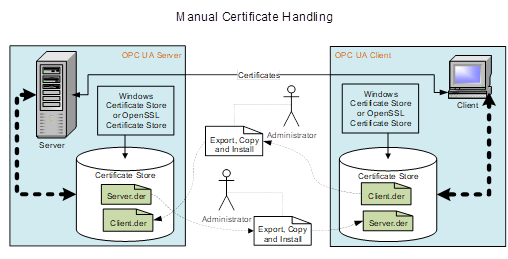
Figure 11 – Manual Certificate handling
An administrator would be required to copy the Public Key associated with all Client applications to all Server applications that they need to communicate with. In addition, the administrator would be required to copy the Public Key associated with all Server applications to all Client applications that need to communicate with them. As the number of Servers and Clients grows, the administration effort can become too burdensome. In addition, a Certificate has a lifetime and will need to be replaced with an updated Certificate at some point in time. This will require that new Private Keys and Public Keys be generated and all of the Public Keys to be copied again. In very small installations, explicitly listing what Clients a Server trusts by installing the Public Key of the Client ApplicationInstanceCertificate in the Trusted Certificate store of the Server could be acceptable.
In systems with multiple Servers and Clients the installation of Public Keys in TrustLists can very quickly become cumbersome. In these instances, the use of a company specific CA can greatly simplify the installation/configuration issues. The CA can also provide additional benefits such as management of Certificate expiration and Certificate Revocation Lists (CRL). Figure 12 provides an illustration of this activity.
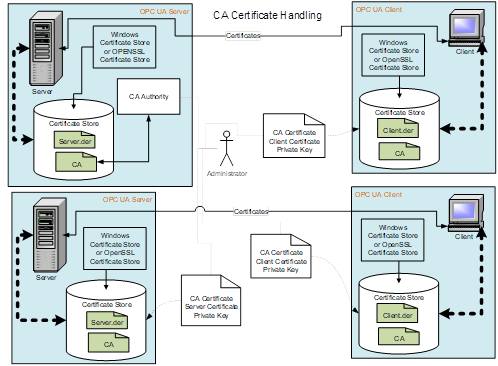
Figure 12 – CA Certificate handling
The administrator will need to generate a CA signed ApplicationInstanceCertificate for all Clients and Servers that are installed in a system, but he will only need to install the CA Public Key on all machines. When a Certificate expires and is replaced, the administrator will only need to replace the expired Certificate (Public Keys and Private Keys), there will be no need to copy a Public Key to any locations.
The company specific CA allows the company to control the issuing of Certificates. The use of a commercial CA (such as VeriSign) would not be recommended in most cases. An OPC UA Application typically is configured to trust only the other applications determined by the Company as trusted. If all Certificates issued by a commercial CA were to be trusted then the commercial CA would be controlling which applications are to be trusted, not the company.
Certificate management needs to be addressed by all application developers. Some applications make use of Certificate management that is provided as part of a system wide infrastructure, others will generate self-signed Certificates as part of an installation. See OPC 10000-12 for additional details on system wide infrastructures for Certificate management.
In some systems, a GlobalDiscoveryServer with Certificate Management could be deployed. The GlobalDiscoverServer will either push certificates to Clients and Servers or allow Servers and Clients to pull certificates. The GlobalDiscoveryServer certificate management can manage all certificate deployments; this includes TrustLists, CAs and CRLs.
From a developer point of view, it is a best practice for your OPC UA Application to automatically provide a self-signed ApplicationInstanceCertificate on installation. In addition, the OPC UA Application is able to easily replace the self-signed ApplicationInstanceCertificate with a CA issued ApplicationInstanceCertificate or have the self-signed certificate signed by a CA. The configuration of a TrustList should also be easily accomplished. Typically, TrustLists for Public Keys of ApplicationInstances are kept in a separate list than those of a CA. Also, an OPC UA Application has to be able to handle Certificate Revocation Lists (CRL). These are lists of Public Keys that are associated with a given CA that have been revoked. This allows a CA to remove a Certificate that it had signed from circulation. CRLs are provided by a CA and usually distributed in some automatic manner; see OPC 10000-12 for additional details. OPC 10000-12 also describes other ObjectTypes that can be used to expose this configuration and manage the all aspect of the security infrastructure.
Developers should also keep in mind that depending on the SecurityPolicies that an OPC UA Application supports, the Application could require multiple Certificates and TrustLists. This is required if both ECC and RSA endpoints are exposed.
From a security point of view, it is essential that the Certificate stores used to store Private Keys.are protected and secured only allowing read/write access by an appropriate administrator and /or by the OPC UA Application. TrustLists, CRLs, and trusted CA lists are secured allowing only write access by an appropriate administrator and in the case of pull configuration by the application. Read access can be granted to other valid users, but the list of users allowed read access would be a site decision.
From an Installation point of view, it is a best practice that a standard tool to generate an ApplicationInstanceCertificate is provided. This tool could be one provided by an OPC UA SDK vendor or by the OPC Foundation. The standard tool ensures that the ApplicationInstanceCertificates that are generated include all of the required fields and settings. A particular OPC UA Application should be able to accept and install any valid ApplicationInstanceCertificates generated by external tools. The choice of the actual tool is site specific. Figure 13 provides an overview of some of the key points of Certificate handling.
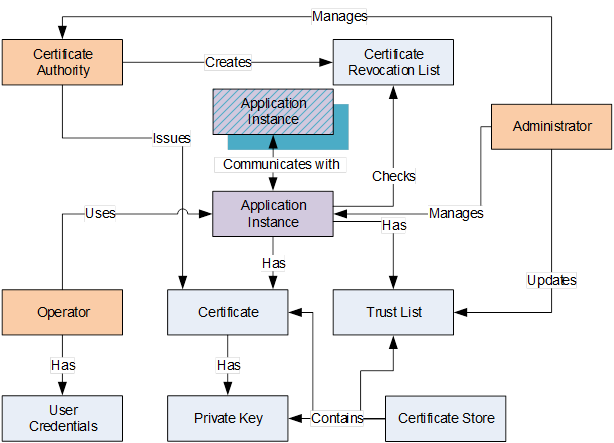 Figure 13 – Certificate handling
The following is a summary of these key points when a CA based security system is deployed:
· ApplicationInstance – An OPC UA Application installed on a single machine is called an ApplicationInstance. Each instance has its own ApplicationInstanceCertificate which it uses to identify itself when connecting to other OPC UA Applications (the Public Key and Private Key). Each ApplicationInstance has a globally unique URI which identifies it. The OPC UA Application will also check TrustLists and CRL’s to determine if access should be granted. The OPC UA Application will communicate using a SecureChannel established using Asymmetric Cryptography with other applications.
· Administrator – The person or persons that administer the Certificate handling associated with a UA system and manage the security settings for ApplicationInstances. This includes setting the contents of TrustLists and managing any activities performed by a CA.
· Operator – An Operator is person who uses the ApplicationInstance. More than one Operator can exist for any given OPC UA Application. An Operator can have User Credentials which are used to determine access rights and to track activities within the ApplicationInstance.
· User Credential – A User Credential is a generic term for an electronic ID which identifies an Operator/User. It can be passed to a Server after the ApplicationInstanceCertificate is used to create a SecureChannel. It can be used to determine access rights and to track activities (auditing).
· Certificate Authority (CA) – A Certificate Authority (CA) is an administrator or organization which is responsible for creating and managing Certificates (it is usually a partially automated software product). The Certificate Authority verifies that information placed in the ApplicationInstanceCertificate is correct and adds a Digital Signature to the Certificate that is used to verify that the information has not been changed. Each CA has its own Certificate which is used to create the Digital Signatures. A CA is also responsible for maintaining CRLs. In most cases it is a software package that an administrator periodically reviews or accesses, usually when the software package generates an alarm or notification that some review action is required.
· Certificate – A Certificate is an electronic ID that can be held by an OPC UA Application. The ID includes information that identifies the holder, the issuer, and a unique key that is used to verify Digital Signatures created with the associated Private Key. The syntax of these Certificates conforms to the X.509 specification and as a result these Certificates are also called “X.509 Certificates”.
· Self-Signed Certificate – A self-signed Certificate is a Certificate which has no Certificate Authority. These Certificates can be created by anyone and can be used in situations where the administrators of OPC UA Applications are able to verify the claims by reviewing the contents themselves. A system that uses only self-signed Certificates would not have CA or CRL.
· Private Key – A Private Key is a secret number known only to the holder of a Certificate. This secret allows the holder to create Digital Signatures and decrypt data. If this secret is revealed to unauthorized parties then the associated Certificate can no longer be trusted or used. It is replaced or in the case of a CA generated Certificate it is revoked.
· TrustList – When security is enabled, OPC UA Applications reject connections from peers whose Certificates are not in the trusted list or if the Certificate is issued by a CA that is not in the TrustList.
· Certificate Store – A Certificate Store is a place where Certificates and Private Keys can be stored on a file system. All Windows systems provide a registry based store called the Windows Certificate Store. All UA systems can also support a directory containing the Certificates stored in a file which is also called an OpenSSL Certificate Store. In all cases the Certificate Store needs to be secured, in that only administrators are allowed to write new entries. The security should follow the 'least privileged' principle, in that read or write access is only allowed to those who really need the data. This means that an administrator for example can store a Private Key but is not allowed to read them, and conversely an UA application can read such Private Keys, but cannot write them.
· Revocation List – A Revocation List is a list of Certificates which have been revoked by a CA and are not accepted by an ApplicationInstance.
Annex A
Mapping
to ISA/IEC 62443
This Annex provides a mapping of ISA/IEC 62443 to OPC UA. The first 5 columns (yellow color) in each table are from the IEC 62443 specification and are included here for clarity. Some topics in ISA/IEC 62443 do not apply to OPC UA and are marked as “N”. ISA/IEC 62443 topics that do apply are marked as “Y”. ISA/IEC 62443 topics that are partially covered are marked as “P”, For each topic that does apply the table lists the relevant OPC UA Parts and the Profiles/ ConformanceUnits that covers the listed functionality. For each OPC UA Part that is listed (other than OPC 10000-7) the text in the “Keyword text or comment” column is the text that should be searched for. The section that are found related to the keyword will describe the OPC UA related functionality. For the row labelled OPC 10000-7, the keyword column contains the actual Profile or ConformanceUnits that apply. For more detail on the ConformanceUnit or Profile, please use the on-line Profile Application available at https://profiles.opcfoundation.org.
Columns 2 through 4 in each of the tables could include a checkmark. The check marks when present indicate that the specific 62443 requirement applies to the listed security level (SL). This information is provided by the IEC 62443 specification and is reproduced here as a convenience.
The tables are broken into seven separate tables, one for each of the foundational requirements;
1. Identification and authentication control (Table A.)
2. Use control (Table A.)
3. System integrity (Table A.)
4. Data confidentiality (Table A.)
5. Restricted data flow (Table A.)
6. Timely response to events (Table A.)
7. Resource availability (Table A.)
Table A.1 – ISA/IEC 62443 Mapping FR 1 Identification and authentication control
|
ISA-62443-4-2 CRs and Res |
Related to |
Applies to OPC UA |
OPC UA Part # |
Keyword text or comment |
|||
|
SL1 |
SL2 |
SL3 |
SL4 |
||||
|
CR 1.1: Human user identification and authentication |
√ |
√ |
√ |
√ |
Y |
OPC 10000-4 |
IssuedIdentityToken |
|
OPC 10000-6 |
JSON Web Token (JWT), JWT UserTokenPolicy |
||||||
|
OPC 10000-7 |
Security User JWT IssuedToken, Security User JWT Token Policy, OPC UA Authority Profile |
||||||
|
CR 1.1 RE (1): Unique identification and Authentication |
|
√ |
√ |
√ |
Y |
OPC 10000-4 |
IssuedIdentityToken |
|
OPC 10000-6 |
JSON Web Token (JWT), JWT UserTokenPolicy |
||||||
|
OPC 10000-7 |
Security User JWT IssuedToken, Security User JWT Token Policy, OPC UA Authority Profile User Token JWT Server Facet, User Token JWT Client Facet |
||||||
|
CR1.1 RE(2) Multifactor authentication for all interfaces` |
|
|
√ |
√ |
P |
|
OPC UA does not define any alternate schemes for two factor authentication, but if Issued tokens are used for user Authentication, the issued token provider can implement multifactor authentication. OPC UA authenticates the application as well as the user. |
|
OPC 10000-4 |
IssuedIdentityToken |
||||||
|
OPC 10000-6 |
JSON Web Token (JWT), JWT UserTokenPolicy |
||||||
|
OPC 10000-7 |
Security User JWT IssuedToken, Security User JWT Token Policy, OPC UA Authority Profile User Token JWT Server Facet, User Token JWT Client Facet |
||||||
|
CR 1.2: Software process and device identification and authentication |
|
√ |
√ |
√ |
Y |
OPC 10000-2 |
ApplicationAuthentication, X.509 v3 Security Certificates |
|
OPC 10000-4 |
ApplicationInstance Security Certificate |
||||||
|
OPC 10000-6 |
EndpointDescription, EndpointUrl, Hostname (Device) |
||||||
|
OPC 10000-7 |
Security Default ApplicationInstance Security Certificate, Global Security Certificate Management Server Facet |
||||||
|
CR 1.2 RE (1) Unique identification and authentication |
|
|
√ |
√ |
Y |
OPC 10000-2 |
ApplicationAuthentication, X.509 v3 Security Certificates |
|
OPC 10000-4 |
ApplicationInstance Security Certificate |
||||||
|
OPC 10000-6 |
EndpointDescription, EndpointUrl, Hostname (Device) |
||||||
|
OPC 10000-7 |
Security Default ApplicationInstance Security Certificate, Global Security Certificate Management Server Facet |
||||||
|
CR 1.3: Account management |
√ |
√ |
√ |
√ |
P |
|
OPC UA does not directly provide account management, but if an AuthorizationService is used for user Authentication, it could support account management |
|
OPC 10000-4 |
IssuedIdentityToken |
||||||
|
OPC 10000-6 |
JSON Web Token (JWT), JWT UserTokenPolicy |
||||||
|
OPC 10000-7 |
Security User JWT IssuedToken, Security User JWT Token Policy, OPC UA Authority Profile User Token JWT Server Facet, User Token JWT Client Facet |
||||||
|
CR 1.4: Identifier management |
√ |
√ |
√ |
√ |
Y |
OPC 10000-4 |
UserIdentityToken, UserTokenPolicy |
|
OPC 10000-7 |
Security User JWT IssuedToken, Security User JWT Token Policy, OPC UA Authority Profile |
||||||
|
User Token JWT Server Facet, User Token JWT Client Facet |
|||||||
|
CR 1.5: Authenticator management |
√ |
√ |
√ |
√ |
Y |
OPC 10000-4 |
UserIdentityToken, UserTokenPolicy |
|
OPC 10000-7 |
Security User JWT IssuedToken, Security User JWT Token Policy, OPC UA Authority Profile |
||||||
|
User Token JWT Server Facet, User Token JWT Client Facet |
|||||||
|
CR 1. 5 RE (1) Hardware security for authenticators |
|
|
√ |
√ |
N |
|
Secure elements are recommended in 8.1 and also discussed in OPC 10000-12 and OPC 10000-21, but not defined in OPC. |
|
NDR 1.6 – Wireless access management |
√ |
√ |
√ |
√ |
N |
|
OPC UA does specify physical characteristics of a network including wireless. |
|
NDR 1.6 RE (1) Unique identification and authentication |
|
√ |
√ |
√ |
N |
|
Same as above |
|
CR 1.7: Strength of password based authentication |
√ |
√ |
√ |
√ |
N |
|
OPC UA provides the mechanism for exchanging passwords information, but it does not define the implementation of the password – this is vendor specific. If an AuthorizationService is used, it can provide password strength enforcement |
|
CR 1.7 RE (1) Password generation and lifetime restrictions for human users |
|
|
√ |
√ |
N |
|
Same as CR 1.7 above |
|
CR 1.7 RE (2) Password lifetime restrictions for all users (human, software process, or device) |
|
|
|
√ |
N |
|
Same as CR 1.7 above |
|
CR 1.8: Security certificates |
|
√ |
√ |
√ |
Y |
OPC 10000-2 |
Security Certificates, TrustLists (CertificateStore), OPC UA Security Services |
|
OPC 10000-4 |
Obtaining, validating, and installing Security Certificate services |
||||||
|
OPC 10000-6 |
Security Certificates |
||||||
|
OPC 10000-7 |
Security Administration, Global Security Certificate Management |
||||||
|
OPC 10000-12 |
Security Certificate Management Overview |
||||||
|
CR 1.9: Strength of public key-based authentication |
|
√ |
√ |
√ |
Y |
OPC 10000-2 |
Cryptographic Keys |
|
OPC 10000-4 |
Trusted Security Certificates |
||||||
|
OPC 10000-7 |
Security Profiles: Basic256_Limits, SecurityPolicy [B] – Basic256Sha256 |
||||||
|
CR 1.9 RE (1) Hardware security for public key-based authentication |
|
|
√ |
√ |
N |
|
Secure elements are recommended in 8.1 and also discussed in OPC 10000-12 and OPC 10000-21, but not defined in OPC. |
|
CR 1.10: Authenticator feedback |
√ |
√ |
√ |
√ |
Y |
OPC 10000-2 |
ApplicationAuthentication, X.509 v3 Security Certificates |
|
OPC 10000-4 |
ApplicationInstance Security Certificate |
||||||
|
OPC 10000-6 |
EndpointDescription, EndpointUrl, Hostname (Device) |
||||||
|
OPC 10000-7 |
Security Default ApplicationInstance Security Certificate, Global Security Certificate Management Server Facet |
||||||
|
CR 1.11: Unsuccessful login attempts |
√ |
√ |
√ |
√ |
N |
|
OPC does not provide temporary lock out for user access failure, but an AuthenticationService could. OPC does monitor SecureChannel connection and could block secure channel connection for repeated failure. |
|
CR 1.12: System use notification |
√ |
√ |
√ |
√ |
N |
|
OPC does not define the how a client prompts for username/password. |
|
NDR 1.13 – Access via untrusted networks |
√ |
√ |
√ |
√ |
N |
|
OPC does not define network hardware requirements. It can restrict communication to be between uniquely identified applications. (see CR 1.2) |
|
NDR 1.13 RE (1) Explicit access request approval |
|
|
√ |
√ |
N |
|
Same as NDR 1.13 above |
|
CR 1.14: Strength of symmetric key-based authentication |
|
√ |
√ |
√ |
Y |
OPC 10000-2 |
Symmetric Encryption |
|
OPC 10000-6 |
SymmetricEncryptionAlgorithm |
||||||
|
OPC 10000-7 |
Global Service Key Credential Pull/Push Facets, KeyCredential Service Server Facet, KeyCredential Service Client Facet |
||||||
|
Part 14 |
SecuritKeyService (SKS), SymmetricEncryptionAlgorithm |
||||||
|
CR 1.14 RE (1) Hardware security for symmetric key-based authentication |
|
|
√ |
√ |
N |
|
The OPC UA specification does not provide hardware requirements and does not utilize long lived symmetric keys |
Table A.2 – ISA/IEC 62443 mapping FR 2 Use control
|
ISA-62443-4-2 CRs and Res |
Related to |
Applies to OPC UA |
OPC UA Part # |
Keyword text or comment |
|||
|
SL1 |
SL2 |
SL3 |
SL4 |
||||
|
CR 2.1: Authorization enforcement |
√ |
√ |
√ |
√ |
Y |
OPC 10000-2 |
UserAuthorization |
|
OPC 10000-4 |
Authorization Services, IssuedIdentityToken |
||||||
|
OPC 10000-6 |
AuthorizationService, JSON Web Token (JWT) |
||||||
|
OPC 10000-7 |
User Token – JWT Server Facet, User Token – JWT Client Facet |
||||||
|
RE (1): Authorization enforcement for all users (humans, software processes, and devices) |
|
√ |
√ |
√ |
Y |
OPC 10000-2 |
UserAuthorization |
|
OPC 10000-4 |
Authorization Services, IssuedIdentityToken |
||||||
|
OPC 10000-6 |
AuthorizationService, JSON Web Token (JWT) |
||||||
|
OPC 10000-7 |
User Token – JWT Server Facet, User Token – JWT Client Facet |
||||||
|
RE (2): Permission mapping to roles |
|
√ |
√ |
√ |
Y |
OPC 10000-2 |
Roles, JWT, and User Roles |
|
OPC 10000-18 |
User Authorization, Role Type |
||||||
|
OPC 10000-6 |
RolePermissions |
||||||
|
OPC 10000-7 |
User Role Management Server/Client Facets |
||||||
|
CR 2.1 RE (3) Supervisor override |
|
|
√ |
√ |
P |
|
OPC provides the ability to switch user context, but it does not provide an automatic timeout for a switch |
|
OPC 10000-4 |
Authorization Services |
||||||
|
CR 2.1 RE (4) Dual approval |
|
|
|
√ |
N |
|
OPC does not define the logic for applications and thus does not define dual approval |
|
CR 2.2: Wireless use control |
√ |
√ |
√ |
√ |
N |
|
OPC is hardware agnostic. |
|
CR 2.3 – Use control for portable and mobile devices |
NA |
NA |
NA |
NA |
N |
|
No component level requirements defined in 62443 |
|
SAR 2.4: Mobile code |
√ |
√ |
√ |
√ |
N |
|
OPC does not define Mobile code technologies |
|
SAR 2.4 RE (1): Mobile code authenticity check |
|
√ |
√ |
√ |
N |
|
OPC does not define Mobile code technologies |
|
EDR 2.4: Mobile code |
√ |
√ |
√ |
√ |
N |
|
OPC does not define Mobile code technologies |
|
EDR 2RE (1): Mobile code authenticity check |
|
√ |
√ |
√ |
N |
|
OPC does not define Mobile code technologies |
|
HDR 2.4: Mobile code |
√ |
√ |
√ |
√ |
N |
|
OPC does not define Mobile code technologies |
|
HDR 2.4RE (1): Mobile code authenticity check |
|
√ |
√ |
√ |
N |
|
OPC does not define Mobile code technologies |
|
NDR 2.4 – Mobile code |
√ |
√ |
√ |
√ |
N |
|
OPC does not define Mobile code technologies |
|
NDR 2.4 – Mobile code |
|
√ |
√ |
√ |
N |
|
OPC does not define Mobile code technologies |
|
CR 2.5: Session lock |
√ |
√ |
√ |
√ |
N |
|
OPC UA does not define human user interface |
|
CR 2.6: Remote session termination |
|
√ |
√ |
√ |
P |
|
OPC allows identification of remote session via ApplicationAuthentication, remote restrictions are application specific, but the infrastructure is provided. |
|
OPC 10000-4 |
IssuedIdentityToken |
||||||
|
OPC 10000-6 |
JSON Web Token (JWT), JWT UserTokenPolicy |
||||||
|
OPC 10000-7 |
Security User JWT IssuedToken, Security User JWT Token Policy, OPC UA Authority Profile |
||||||
|
CR 2.7 – Concurrent session control |
|
|
√ |
√ |
N |
|
OPC provides limits on sessions, subscription and other functionality and defines behaviour if these limits are exceeded, but it does not provide limits per user. |
|
CR 2.8: Auditable events |
√ |
√ |
√ |
√ |
Y |
OPC 10000-2 |
Auditability, Auditing, Audit Event Management |
|
OPC 10000-4 |
Auditing |
||||||
|
OPC 10000-5 |
AuditSecurityEventType |
||||||
|
OPC 10000-7 |
Auditing Server Facet, Auditing Client Facet, Best Practice – Audit Events |
||||||
|
CR 2.9: Audit storage capacity |
√ |
√ |
√ |
√ |
N |
|
OPC does not define Audit storage. |
|
CR 2.9 RE (1) Warn when audit record storage capacity threshold reached. |
|
|
√ |
√ |
N |
|
OPC does not define Audit storage. |
|
CR 2.10: Response to audit processing failures |
√ |
√ |
√ |
√ |
N |
|
OPC does not provide Audit storage |
|
CR 2.11: Timestamps |
√ |
√ |
√ |
√ |
Y |
OPC 10000-2 |
Message replay, Timestamps, SecureChannelId |
|
OPC 10000-4 |
TimestampsToReturn |
||||||
|
OPC 10000-5 |
AuditEventType |
||||||
|
OPC 10000-7 |
Auditing Server Facet |
||||||
|
CR 2.11 RE (1): Time synchronization |
|
√ |
√ |
√ |
Y |
OPC 10000-2 |
Cryptographic Keys (time validity of security profile) |
|
OPC 10000-4 |
SourceTimestamp, VersionTime, Redundant Server Set Requirements |
||||||
|
OPC 10000-6 |
Time Synchronization |
||||||
|
OPC 10000-7 |
Security Time Synchronization |
||||||
|
CR 2.11 RE (2) Protection of time source integrity |
|
|
|
√ |
N |
|
OPC does not define a unique time synchronization scheme, but utilize other industry standard. |
|
CR 2.12: Non-repudiation |
√ |
√ |
√ |
√ |
Y |
OPC 10000-2 |
Message alteration, Server Profiling, System Hijacking, Repudiation, Audit Event Management |
|
OPC 10000-4 |
Signing, GetEndpoints, SecureChannel, Auditing, Proof of Possession, |
||||||
|
OPC 10000-7 |
User Token – JWT Server/Client Facets, Auditing Server Facet, Auditing Client Facet, Best Practice – Audit Events |
||||||
|
CR 2.12 RE (1) Non-repudiation for all users |
|
|
|
√ |
Y |
OPC 10000-2 |
Message alteration, Server Profiling, System Hijacking, Repudiation, Audit Event Management |
|
OPC 10000-4 |
Signing, GetEndpoints, SecureChannel, Auditing, Proof of Possession, |
||||||
|
OPC 10000-7 |
User Token – JWT Server/Client Facets, Auditing Server Facet, Auditing Client Facet, Best Practice – Audit Events |
||||||
|
EDR 2.13: Use of physical diagnostic and test interfaces |
|
√ |
√ |
√ |
N |
|
OPC is hardware agnostic. |
|
EDR 2.13 RE (1) Active monitoring |
|
|
√ |
√ |
N |
|
OPC is hardware agnostic |
|
HDR 2.13: Use of physical diagnostic and test interfaces |
|
√ |
√ |
√ |
N |
|
OPC is hardware agnostic |
|
HDR 2.13 RE (1) Active monitoring |
|
|
√ |
√ |
N |
|
OPC is hardware agnostic |
|
NDR 2.13: Use of physical diagnostic and test interfaces |
|
√ |
√ |
√ |
N |
|
OPC is hardware agnostic |
|
NDR 2.13 RE (1) Active monitoring |
|
|
√ |
√ |
N |
|
OPC is hardware agnostic |
Table A.3 – ISA/IEC 62443 Mapping FR 3 System integrity
|
ISA-62443-4-2 CRs and Res |
Related to |
Applies to OPC UA |
OPC UA Part # |
Keyword text or comment |
|||
|
SL1 |
SL2 |
SL3 |
SL4 |
||||
|
CR 3.1: Communication integrity |
√ |
√ |
√ |
√ |
Y |
OPC 10000-2 |
SecureChannel – OpenSecureChannel |
|
OPC 10000-4 |
SecureChannel Service Set |
||||||
|
OPC 10000-6 |
SecureChannel, SecurityProtocol |
||||||
|
OPC 10000-7 |
Security Policy Required, Security Policy [A] & [B] |
||||||
|
CR 3.1 RE (1): Communication authentication |
|
√ |
√ |
√ |
Y |
OPC 10000-2 |
SecureChannel – OpenSecureChannel |
|
OPC 10000-4 |
SecureChannel Service Set |
||||||
|
OPC 10000-6 |
SecureChannel |
||||||
|
OPC 10000-7 |
Security Policy Required, Security |
||||||
|
SAR 3.2: Protection from malicious code |
√ |
√ |
√ |
√ |
N |
|
OPC does not define requirement related to malicious code protection (for example. virus checkers) |
|
EDR 3.2: Protection from malicious code |
√ |
√ |
√ |
√ |
N |
|
OPC does not define requirement related to installation or execution of software |
|
HDR 3.2: Protection from malicious code |
√ |
√ |
√ |
√ |
N |
|
OPC does not define requirement related to malicious code protection (for example. virus checkers) |
|
HDR 3.2 RE (1): Report version of code protection |
|
√ |
√ |
√ |
N |
|
OPC does not define requirement related to malicious code protection (for example. virus checkers) |
|
NDR 3.2 – Protection from malicious code |
√ |
√ |
√ |
√ |
N |
|
OPC does not define requirement related to malicious code protection (for example. virus checkers) |
|
CR 3.3: Security functionality verification |
√ |
√ |
√ |
√ |
Y |
OPC 10000-2 |
Identity Provider, SecurityKeyService, SecureChannel, TLS |
|
OPC 10000-4 |
OpenSecureChannel, CreateSession, Write |
||||||
|
OPC 10000-6 |
OPC UA Secure Conversation (UASC), Verifying Message Security, Token Policy, Bad_SecureChannel |
||||||
|
OPC 10000-7 |
User Token – JWT Server/Client facets, Security Policy [A] & [B] |
||||||
|
CR 3.3 RE (1) Security functionality verification during normal operation |
|
|
|
√ |
N |
|
OPC does not define security function verification |
|
CR 3.4: Software and information integrity |
√ |
√ |
√ |
√ |
P |
OPC 10000-2 |
ApplicationInstance Security Certificate |
|
OPC 10000-4 |
SoftwareCertificates |
||||||
|
OPC 10000-6 |
ApplicationInstance Security Certificate, X.509 v3 |
||||||
|
OPC 10000-7 |
Security ApplicationInstance Security Certificate, Global Security Certificate Management Server/Client Profiles |
||||||
|
CR 3.4 RE (1): Authenticity of software and information |
|
√ |
√ |
√ |
P |
OPC 10000-2 |
ApplicationInstance Security Certificate |
|
OPC 10000-4 |
SoftwareCertificates |
||||||
|
OPC 10000-6 |
ApplicationInstance Security Certificate, X.509 v3 |
||||||
|
OPC 10000-7 |
Security ApplicationInstance Security Certificate, Global Security Certificate Management Server/Client Profiles |
||||||
|
CR 3.4 RE (2) Automated notification of integrity violations |
|
|
√ |
√ |
P |
OPC 10000-2 |
ApplicationInstance Security Certificate |
|
OPC 10000-4 |
SoftwareCertificates |
||||||
|
OPC 10000-6 |
ApplicationInstance Security Certificate, X.509 v3 |
||||||
|
OPC 10000-7 |
Security ApplicationInstance Security Certificate, Global Security Certificate Management Server/Client Profiles |
||||||
|
CR 3.5: Input validation |
√ |
√ |
√ |
√ |
N |
|
OPC does not define HMI requirements, but does ensure that input data (method parameter or for write) is of the correct datatype |
|
CR 3.6: Deterministic output |
√ |
√ |
√ |
√ |
N |
|
OPC does not define application behaviour, but does define information models that include substituted values and other behaviours for failed states. |
|
CR 3.7: Error handling |
√ |
√ |
√ |
√ |
Y |
OPC 10000-4 |
Request/Response Service |
|
OPC 10000-5 |
SessionDiagnosticsObjectType |
||||||
|
OPC 10000-6 |
MessageChunks, Error Handling, Error Message, CloseSecureChannel |
||||||
|
OPC 10000-7 |
Security Policy Required, Security Policy [A] & [B] |
||||||
|
CR 3.8: Session integrity |
|
√ |
√ |
√ |
Y |
OPC 10000-2 |
SecureChannel, Session ID |
|
OPC 10000-4 |
Session Service Set, Creating a Session, Auditing Session Service, SessionAuthenticationToken |
||||||
|
OPC 10000-7 |
Session Services Facets, Standard UA Client 2017 Profile, Base Server Behavior Facet |
||||||
|
CR 3.9: Protection of audit information |
|
√ |
√ |
√ |
P |
|
OPC provides security related to Audit event generation, but does not define Audit Logging requirements or tools for analysing audit records |
|
OPC 10000-2 |
SecureChannel, Session ID |
||||||
|
OPC 10000-4 |
Session Service Set, Creating a Session, Auditing Session Service, SessionAuthenticationToken |
||||||
|
OPC 10000-7 |
Session Services Facets, Standard UA Client 2017 Profile, Base Server Behavior Facet |
||||||
|
CR 3.9 RE (1) Audit records on write-once media |
|
|
|
√ |
N |
|
OPC does not define hardware requirements |
|
EDR 3.10: Support for updates |
√ |
√ |
√ |
√ |
N |
|
Some companion specification can define additional functionality that would apply, such as OPC 10000-100 |
|
EDR 3.10: RE (1): Update authenticity and integrity |
|
√ |
√ |
√ |
N |
|
|
|
HDR 3.10: Support for updates |
√ |
√ |
√ |
√ |
N |
|
|
|
HDR 3.10 RE (1): Update authenticity and integrity |
|
√ |
√ |
√ |
N |
|
|
|
NDR 3.10 – Support for updates |
√ |
√ |
√ |
√ |
N |
|
|
|
NDR 3.10 RE (1) Update authenticity and integrity |
|
√ |
√ |
√ |
N |
|
|
|
EDR 3.11: Physical tamper resistance and detection |
|
√ |
√ |
√ |
N |
|
|
|
EDR 3.11 RE (1) Notification of a tampering attempt |
|
|
√ |
√ |
N |
|
|
|
HDR 3.11: Physical tamper resistance and detection |
|
√ |
√ |
√ |
N |
|
|
|
HDR 3.11 RE (1) Notification of a tampering attempt |
|
|
√ |
√ |
N |
|
|
|
NDR 3.11 – Physical tamper resistance and detection |
|
√ |
√ |
√ |
N |
|
|
|
NDR 3.11 RE (1) Notification of a tampering attempt |
|
|
√ |
√ |
N |
|
|
|
EDR 3.12: Provisioning product supplier roots of trust |
|
√ |
√ |
√ |
N |
|
|
|
HDR 3.12: Provisioning product supplier roots of trust |
|
√ |
√ |
√ |
N |
|
|
|
NDR 3.12 – Provisioning product supplier roots of trust |
|
√ |
√ |
√ |
N |
|
|
|
EDR 3.13: Provisioning asset owner roots of trust |
|
√ |
√ |
√ |
N |
|
|
|
HDR 3.13: Provisioning asset owner roots of trust |
|
√ |
√ |
√ |
N |
|
|
|
NDR 3.13 – Provisioning asset owner roots of trust |
|
√ |
√ |
√ |
N |
|
|
|
EDR 3.14: Integrity of the boot process |
√ |
√ |
√ |
√ |
N |
|
|
|
EDR 3.14 RE (1): Authenticity of the boot process |
|
√ |
√ |
√ |
N |
|
|
|
HDR 3.14: Integrity of the boot process |
√ |
√ |
√ |
√ |
N |
|
|
|
HDR 3.4 RE (1): Authenticity of the boot process |
|
√ |
√ |
√ |
N |
|
|
|
NDR 3.14 – Integrity of the boot process |
√ |
√ |
√ |
√ |
N |
|
|
|
NDR 3.14 RE (1) Authenticity of the boot process |
|
√ |
√ |
√ |
N |
|
|
Table A.4 – ISA/IEC 62443 Mapping FR 4 Data confidentiality
|
ISA-62443-4-2 CRs and Res |
Related to |
Applies to OPC UA |
OPC UA Part # |
Keyword text or comment |
|||
|
SL1 |
SL2 |
SL3 |
SL4 |
||||
|
CR 4.1: Information confidentiality |
√ |
√ |
√ |
√ |
Y |
OPC 10000-2 |
Confidentiality, Confidentiality, Eavesdropping, Client/Server, PubSub, Confidentiality |
|
OPC 10000-4 |
SecureChannel Service Set |
||||||
|
OPC 10000-6 |
OPC UA HTTPS, WebSockets (Security) |
||||||
|
OPC 10000-7 |
Security Policy Required, Security Policy [A] & [B] |
||||||
|
CR 4.2: Information persistence |
|
√ |
√ |
√ |
N |
|
OPC does not describe hardware |
|
CR 4.2 RE (1) Erase of shared memory resources |
|
|
√ |
√ |
N |
|
OPC does not describe hardware |
|
CR 4.2 RE (2) Erase verification |
|
|
√ |
√ |
N |
|
OPC does not describe hardware |
|
CR 4.3: Use of cryptography |
√ |
√ |
√ |
√ |
Y |
OPC 10000-2 |
Asymmetric Cryptography, Cryptography, Symmetric Cryptography, SecurityPolicies, Random Number Generation, Security Certificate Management |
|
OPC 10000-4 |
GetEndpoints, OpenSecureChannel |
||||||
|
OPC 10000-6 |
Security Handshake, Security Certificates, AccessTokens, Security Header, Deriving Keys (Table 49) |
||||||
|
OPC 10000-7 |
AccessToken Request Client Facet, Security User Access Control Base Profile, Best Practice – Random Numbers, Global Discovery and Security Certificate Management 2017 Server, Global Security Certificate Management Client 2017 Profile |
||||||
|
OPC 10000-12 |
Certificate Management Overview, KeyCredential Management |
||||||
Table A.5 – ISA/IEC 62443 Mapping FR 5 Restricted data flow
|
ISA-62443-4-2 CRs and Res |
Related to |
Applies to OPC UA |
OPC UA Part # |
Keyword text or comment |
|||
|
SL1 |
SL2 |
SL3 |
SL4 |
||||
|
CR 5.1: Network segmentation |
√ |
√ |
√ |
√ |
Y |
OPC 10000-2 |
Network Segmentation, OpenSecureChannel |
|
OPC 10000-7 |
Standard UA Client 2017 Profile, Base Server Behavior Facet |
||||||
|
NDR 5.2 – Zone boundary protection |
√ |
√ |
√ |
√ |
N |
|
OPC does not define network hardware. |
|
NDR 5.2 RE (1) Deny all, permit by exception |
|
√ |
√ |
√ |
N |
|
OPC does not define network hardware. |
|
NDR 5.2 RE (2) Island mode |
|
|
√ |
√ |
N |
|
OPC does not define network hardware. |
|
NDR 5.2 RE (3) Fail close |
|
|
√ |
√ |
N |
|
OPC does not define network hardware. |
|
NDR 5.3 – General purpose, person-to-person communication restrictions |
√ |
√ |
√ |
√ |
N |
|
OPC does not define network hardware. |
|
CR 5.4 – Application partitioning |
NA |
NA |
NA |
NA |
NA |
|
Nothing defined in IEC62443 |
Table A.6 – ISA/IEC 62443 Mapping FR 6 Timely response to events
|
ISA-62443-4-2 CRs and Res |
Related to |
Applies to OPC UA |
OPC UA Part # |
Keyword text or comment |
|||
|
SL1 |
SL2 |
SL3 |
SL4 |
||||
|
CR 6.1: Audit log accessibility |
√ |
√ |
√ |
√ |
N |
|
OPC does not define an Audit log. OPC defines standard Audit records and also defined historical storage of events. It provides access restriction for all data. |
|
CR 6.1 RE (1) Programmatic access to audit logs |
|
|
√ |
√ |
N |
|
OPC Does not define an Audit log. OPC defines standard Audit records and also defined historical storage of events. It provides access restriction for all data, standard methods for programmatical access are defined. |
|
CR 6.2: Continuous monitoring |
|
√ |
√ |
√ |
Y |
OPC 10000-7 |
Monitor Items, GetMonitoredItems Method, SetMonitoringMode. Subscription Server Facet, Standard UA Client 2017 Profile, Standard DataChange Subscription 2017 Server Facet |
Table A.7 – ISA/IEC 62443 Mapping FR 7 Resource availability
|
ISA-62443-4-2 CRs and REs |
Related to |
Applies to OPC UA |
OPC UA Part # |
Keyword text or comment |
|||
|
SL1 |
SL2 |
SL3 |
SL4 |
||||
|
CR 7.1: Denial of service protection |
√ |
√ |
√ |
√ |
Y |
OPC 10000-2 |
Application Crashes, Fuzz Testing, Certification |
|
OPC 10000-4 |
CreateSession, OpenSecureChannel, AuthenticationToken |
||||||
|
OPC 10000-7 |
Session Services Facets, Standard UA Client 2017 Profile, Base Server Behavior Facet |
||||||
|
CR 7.1 RE (1): Manage communication load from component |
|
√ |
√ |
√ |
Y |
OPC 10000-2 |
Message flooding, GetEndpoints, OpenSecureChannel |
|
OPC 10000-4 |
CreateSession, OpenSecureChannel, AuthenticationToken |
||||||
|
OPC 10000-7 |
Session Services Facets, Standard UA Client 2017 Profile, Base Server Behavior Facet |
||||||
|
CR 7.2: Resource management |
√ |
√ |
√ |
√ |
Y |
OPC 10000-2 |
Resource exhaustion, ClientAuthentication, ServerAuditing, OpenSecureChannel |
|
OPC 10000-4 |
CreateSession, OpenSecureChannel, AuthenticationToken |
||||||
|
OPC 10000-7 |
Session Services Facets, Standard UA Client 2017 Profile, Base Server Behavior Facet |
||||||
|
CR 7.3: Control system backup |
√ |
√ |
√ |
√ |
N |
|
OPC does not define system level backup requirements. |
|
CR 7.3 RE (1): Backup integrity verification |
|
√ |
√ |
√ |
N |
|
OPC does not define verification of backup requirements. |
|
CR 7.4: Control system recovery and reconstitution |
|
|
|
|
N |
|
OPC UA does not define backup and restore requirements (to a specific state). |
|
CR 7.5 - Emergency Power |
NA |
NA |
NA |
NA |
NA |
|
(no requirements for this) |
|
CR 7.6: Network and security configuration settings |
√ |
√ |
√ |
√ |
P |
|
OPC UA requires that application can be configured for network and security setting, but it does not define how this is accomplished. |
|
OPC 10000-2 |
ClientAuthentication, OpenSecureChannel |
||||||
|
OPC 10000-4 |
CreateSession, OpenSecureChannel, Discovery |
||||||
|
OPC 10000-7 |
Session Services Facets, Standard UA Client 2017 Profile, B |
||||||
|
CR 7.6 RE (1) Machine-readable reporting of current security settings |
|
|
√ |
√ |
P |
|
This is not defined in an OPA UA specification, but OPC UA does define a machine readable XML format that an application could be used to export the security setting. |
|
OPC 10000-2 |
ClientAuthentication, OpenSecureChannel |
||||||
|
OPC 10000-4 |
CreateSession, OpenSecureChannel, Discovery |
||||||
|
OPC 10000-7 |
Session Services Facets, Standard UA Client 2017 Profile |
||||||
|
CR 7.7: Least functionality |
√ |
√ |
√ |
√ |
N |
OPC 10000-2 |
The OPC UA specification does describe that least functionality is recommended with regard to OPC UA access, but this requirement applies to all service/ports protocols, etc. which is beyond the scope of OPC UA Specifications. |
|
CR 7.8: Control system component inventory |
|
√ |
√ |
√ |
N |
|
This scope is beyond what is defined in core OPC UA specifications. Some companion specification can define additional details about the overall environment in which OPC UA is executing, which could be able to cover this requirement. |
The Open Group has given the OPC Foundation permission to incorporate the above table(s) from their copyrighted documentation: O-PAS™ Standard, Version 2.1, Copyright© 2021 The Open Group. The table has been edited in this version for content, format and structure.
Annex B
ECC vs RSA
OPC UA supports both RSA and ECC for security. This annex provides a brief overview of each and also describes some benefits and limitations of each. Both RSA and ECC utilize the mathematical concept of one-way functions.
RSA provides security using the mathematical concept that it is much more difficult to factor a number than to multiply two large numbers together. RSA uses two keys – a public key and a private key. RSA can be used for digital signatures and for encryption of data. The digital signature is generated using the private key and the public key can be used to validate that it was generated using the private key. For encryption, the data is encrypted using the public key and it can only be decrypted using the private key. There are a number of different algorithms that provide for signatures and encryption using these concepts.
Asymmetric encryption (using the two keys) can be very computationally intensive, can result in large keys and is rather slow, but it is well understood and publicly available. Typically, it is only used to exchange a SymmetricKey which is then used for all communication (signing and encryption).
ECC is based on the algebraic structure of elliptical curves or finite fields (see Figure B.1 for illustration). It depends on being able to compute a point (multiplication) and the difficulty in computing the multiplicand given the original point and the resulting product. The size of the elliptical curve determines how difficult the problem is. For ECC the parameters that define the curve must be known by all. There are a number of well-known curves that can be used.
Figure B.1 – Elliptical Curve Example
Compared to RSA, ECC requires smaller integers and thus much less computational power and has a smaller key to transmit. ECC is only used for signing not encryption, but it does allow for the generation of a shared secret over an un-secured channel (ECDH). Once the shared secrete is generated then Symmetric encryption can be used. ECC is not as well-known as RSA and there are many different curves, some of which are restricted by patents. The patents can apply to the algorithm that are used and / or the technique used. For interoperability it is important that a selected curve is supported by multiple libraries/platforms.
______________